Hindu deities, known as Devas and Devis (gods and goddesses), represent various aspects of the divine and cosmic forces. While Hinduism is often perceived as polytheistic with multiple gods, the underlying philosophy is deeply monistic—all these Hindu gods and goddesses (deities) are considered manifestations or aspects of Brahman, the ultimate divine reality. Each deity embodies specific qualities, powers, and domains, serving as a focus for devotion (Bhakti) and spiritual practice.
Below are brief introductions to widely worshipped deities and Hindu gods: Shiva, Vishnu, Shakti, Muruga, Ganesh, Hanuman, and Surya.
Major categories
Deities can be grouped by cosmic role: the Trimurti (Brahma, Vishnu, Shiva), avatars (see Vishnu and the Dashavatar), goddess forms (Shakti), the Navagraha, and regional deities. In philosophy, Brahman is the formless ultimate reality; Ishvara and the deities are personified expressions that allow devotees to connect with the divine.
The six primary forms of worship in Hinduism, often categorized as Shanmata (six systems), were popularized by Adi Shankaracharya to unify diverse traditions under one Advaita philosophy. They involve the veneration of six main deities:
Vaishnavism (Vishnu): Worship of Vishnu and his avatars as the supreme maintainer of the universe.
Shaivism (Shiva): Focuses on the worship of Shiva, representing the destroyer and transformer within the Trinity.
Shaktism (Shakti/Devi): Worship of the Divine Mother or Goddess (Ambaa, Devi) as the supreme power.
Ganapatyam (Ganesha): Veneration of Ganesha, the remover of obstacles and lord of beginnings.
Kaumaram (Kumara/Murugan): Worship of Kartikeya (also known as Murugan or Kumara), the commander of the divine army.
Saurism (Surya): Worship of Surya, the Sun God, representing light and life.
These six systems allow devotees to choose a primary deity (Ishta Devata) while recognizing all as different aspects of the same supreme Brahman.
Shiva
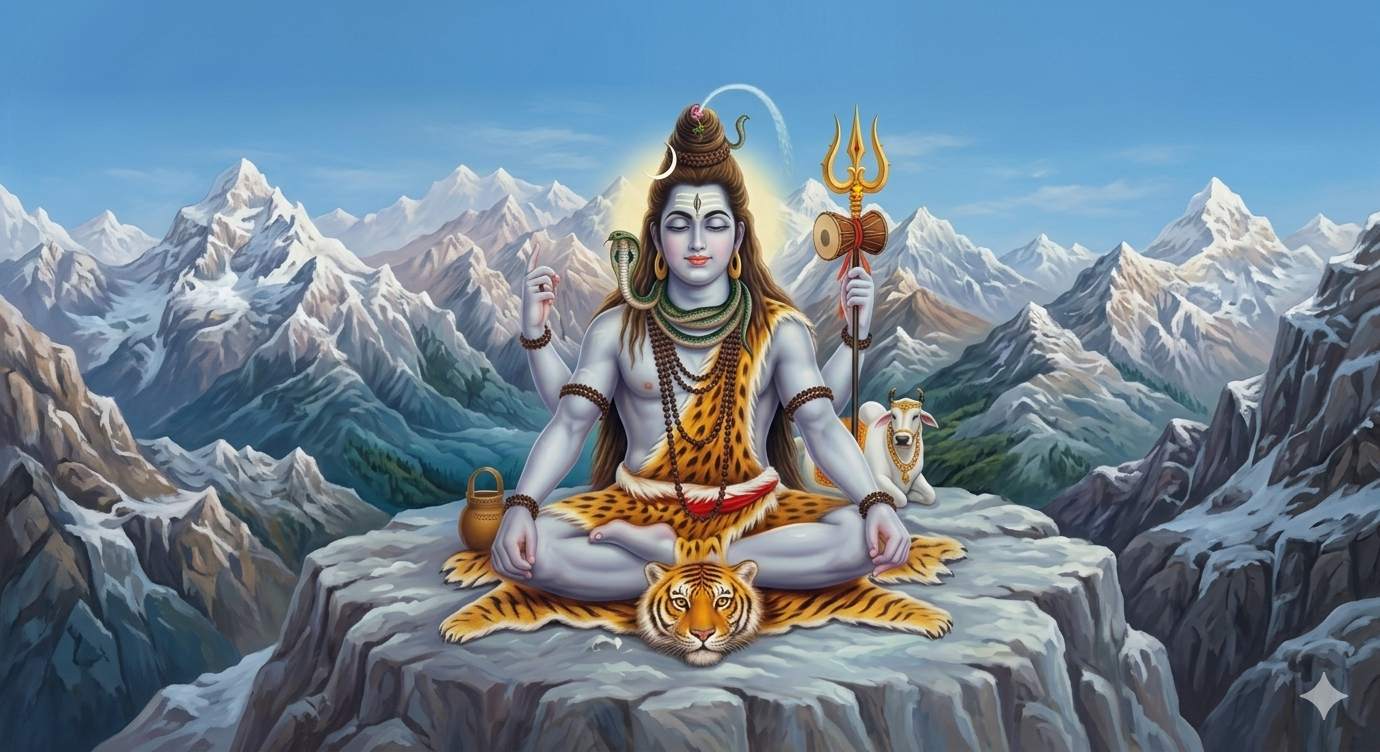
Shiva is one of the principal deities of Hinduism, the destroyer and transformer within the Trimurti (with Brahma the creator and Vishnu the preserver). He is also the supreme being in Shaivism. Shiva is associated with asceticism, yoga, the sacred syllable Om, and the cosmic dance (Tandava). He is often depicted with a third eye, the Ganga in his hair, a crescent moon, and the serpent Vasuki. His consort is Parvati (Shakti), and his sons include Ganesha and Kartikeya (Muruga). The twelve Jyotirlingas and the Panchabhoothasthalams are among the most sacred Shiva temples.
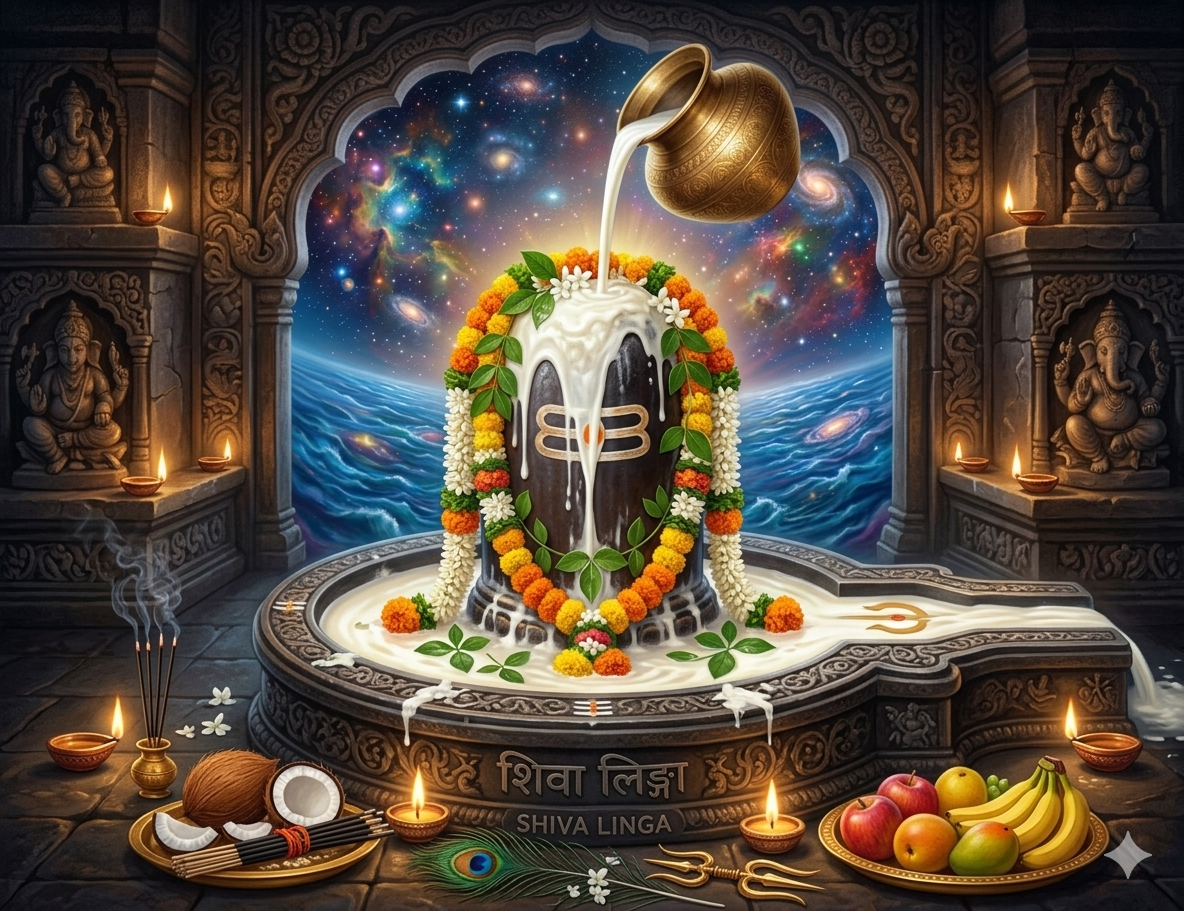
Meaning: The Shiva Linga is revered as the combined presence of Shiva and Shakti—Father and Mother. Shiva (Bharga) is Purusha, the primordial consciousness, and Shakti is Prakriti, the dynamic power of nature.
Shiva is worshipped as the Linga because he is both formless (“niṣkala”) and with form (“sakala”). The word “linga” means a sign or symbol—the mark of the formless Creator. In Shiva Purana, the Linga appears as an infinite pillar of fire (Jyotirlinga) to resolve a dispute between Brahma and Vishnu, revealing Shiva as the beginningless and endless source of all.
The vertical stone of the Linga represents Shiva as pure consciousness, while the circular base (yoni) represents Goddess Parvati as creative energy. Just as a child is born from parents, the universe is poetically seen as emerging from this union of Purusha and Prakriti. For many devotees, worship of the Shiva Linga is therefore a simple yet profound way to approach the highest truth and seek liberation (moksha).
Where does Shiva live?
According to the Shiva Purana, Shiva is described as living at different levels: physically at Mount Kailash and in the high Himalayas, as the wandering Lord who roams the earth with his ganas, and ultimately in Shivaloka, a non-material realm of pure consciousness and light.
Mount Kailash and the Himalayas: The Rudra Samhita narrates that, pleased with Kubera’s penance, Shiva chose to reside near him on Kailash, where a beautiful city was fashioned by Vishwakarma. Other passages describe Shiva dwelling on various Himalayan peaks with Sati and later Parvati.
The wandering Lord: Shiva is also “Svatantra” (independent) and is not bound to any one place. He wanders forests, mountains, and sacred groves with his ganas, blessing devotees wherever they call upon him with devotion.
Shivaloka and the heart of the devotee: Beyond the material universe lies Shivaloka, a realm “niradhara” (unsupported by physical laws) and “abhautika” (non-material), where Shiva is experienced as pure consciousness. In essence, while Kailash is his earthly home, Shiva’s true residence is both in Shivaloka and in the devoted heart that remembers him.
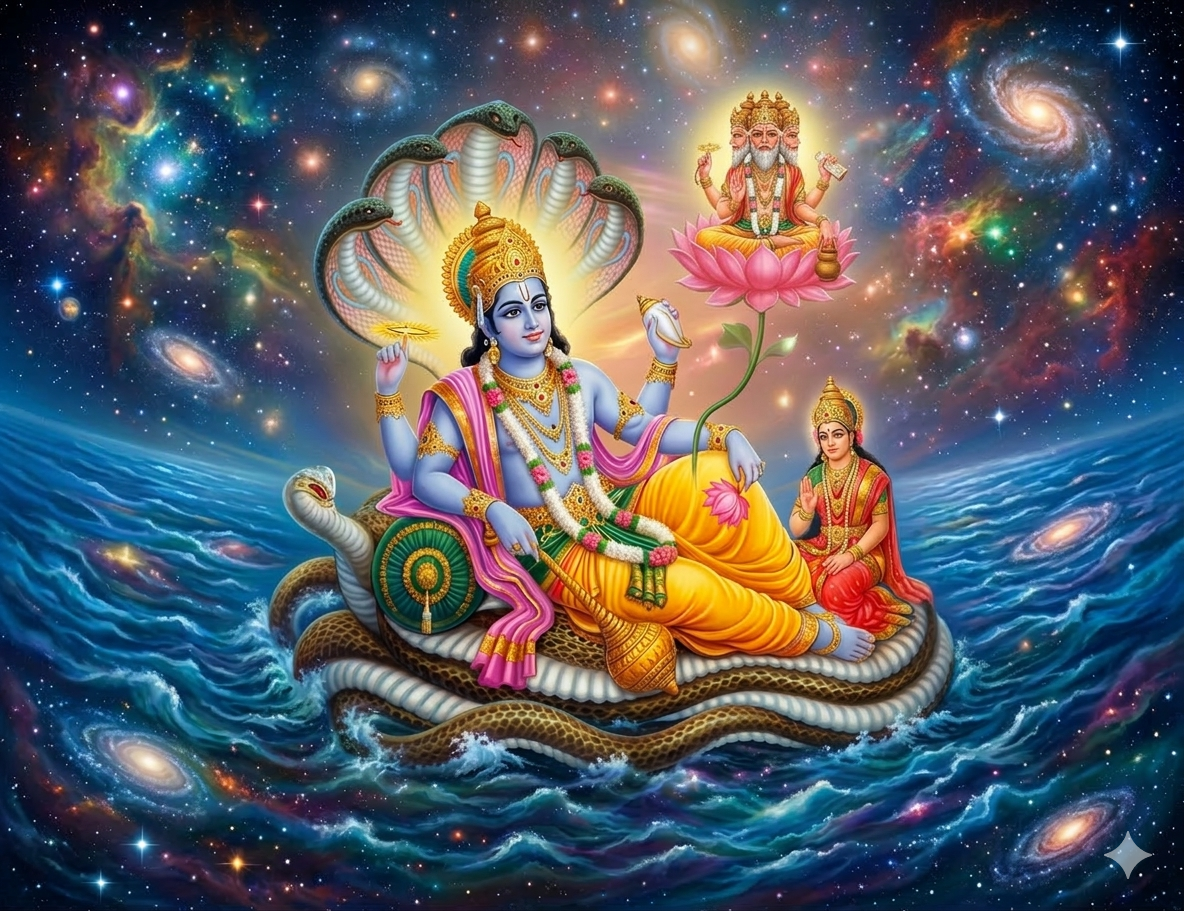
Vishnu is the preserver and sustainer in the Trimurti. In Vaishnavism he is the supreme reality. He is depicted with four arms holding the conch, discus, mace, and lotus, and is often shown resting on the serpent Shesha. His consort is Lakshmi. Vishnu descends to earth in avatars (incarnations) to restore dharma—the ten principal avatars are the Dashavatar, including Rama and Krishna. The 108 Divya Desams are among the most revered Vishnu temples, celebrated in the Tamil Alvar hymns.
Shakti is the divine feminine energy and the creative power of the universe. She is worshipped in many forms: as Parvati (consort of Shiva), Durga (the warrior goddess), Kali (the fierce aspect), Lakshmi (prosperity), and Saraswati (wisdom and arts). The goddess is central to Shaktism, where she is seen as the supreme reality. The 51 Shakti Peethas are sacred sites associated with the goddess, and festivals such as Navaratri and Durga Puja celebrate her many forms.
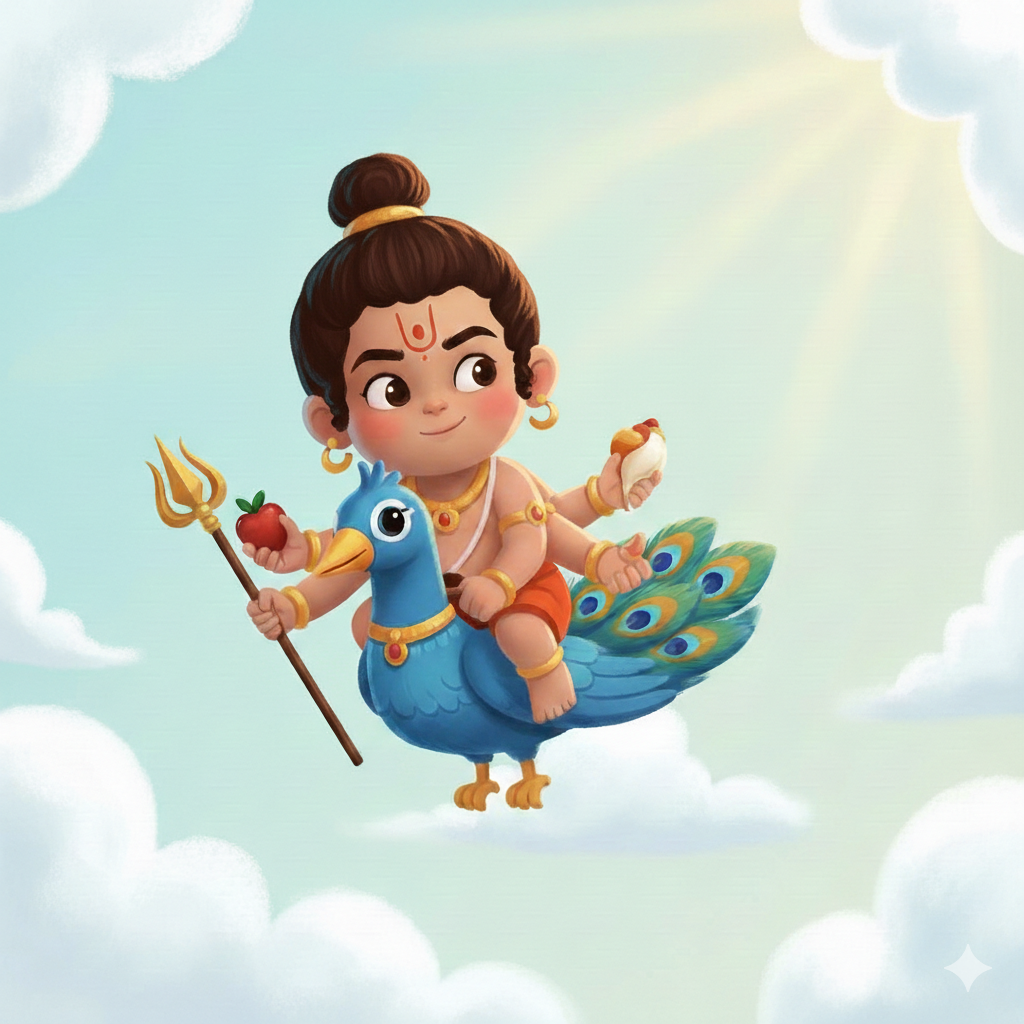
Muruga (also known as Kartikeya, Skanda, or Subrahmanya) is the son of Shiva and Parvati and the brother of Ganesha. He is the god of war, victory, and wisdom, and is widely worshipped in South India, especially in Tamil Nadu. His six sacred abodes are the Arupadai Veedu: Palani, Swamimalai, Thiruthani, Pazhamudircholai, Thiruchendur, and Thirupparankundram. Muruga is depicted with six faces and twelve arms, and his vehicle is the peacock. Thaipusam and Skanda Shashti are major festivals in his honour.
Birth of Karthikeya
In the Shiva Purana (Rudra Samhita), Kartikeya’s emergence is described as a divine chain of events that shows Shiva’s power cannot be confined to one place, one form, or one womb.
Divine potency and the hidden child: When Shiva’s tejas (divine potency) is released, its intensity is too great for the gods to bear. They arrange for it to be carried and protected until it can take form. From this power a radiant child manifests, first known as Guha (“the hidden one”), the mysterious indwelling presence.
Named and armed: Sage Vishvamitra performs rites and names the child Guha. Agni then offers him the divine spear Shakti, signifying that he is born to uphold dharma with decisive spiritual power.
Krauncha mountain and the awakening of the warrior: Guha goes to Krauncha (Kroncha) mountain and shatters it with Shakti. Demons pour out to kill him, but the child defeats them, showing that even in child form, Shiva’s son is already the protector of cosmic order.
Indra’s blows and new companions: Hearing of this brilliance, Indra strikes him three times with the vajra. From these impacts arise three mighty beings—Sakha, Vishakha, and Naigameya—who stand as extensions of Kartikeya’s martial and protective energy.
Six mothers and six faces: When the Krttikas (six divine mothers) arrive, each wishes to nurse the child. To honour them all, Guha manifests six faces so each mother can feed him. Raised by the Krttikas, he becomes Kartikeya, “son of the Krttikas”.
Eternal youth: The Purana says that from then on his kumāratva—his sacred, ever-youthful form—is established, symbolising alertness, courage, and purity. Kartikeya is thus Shiva’s tejas given form, nourished by maternal devotion and armed with divine purpose, a protector whose birth itself teaches that the Divine can manifest through many hands for the welfare of the worlds.
Mantra chant
Om Saravanabhavaya Namah
Mantra: Om Saravanabhavaya Namah
This mantra is considered auspicious to chant for good luck, abundance and prosperity. It salutes Lord Muruga as Saravanabhava (born from the Saravana lake).
108 names of Muruga (Ashtottara Shatanamavali)
This traditional list of 108 names celebrates Muruga as Skanda, Guha, Shanmukha, the commander of the devas, the eternal youth and protector of dharma. Each name highlights a facet of his courage, wisdom, compassion, and divine radiance.
Kanda Sashti Kavacham is a devotional poem by Sri Devaraya Swamigal, praying to Lord Muruga for protection and blessings. It is chanted especially during the six-day Skanda Sashti festival, which marks Lord Muruga's victory over the demon Soorapadman. Regular chanting is believed to remove life's hardships and bring prosperity and peace.
Kandar Anubhuti is a classic Tamil devotional work by Arunagirinathar in praise of Lord Muruga. It has 51 verses (plus an opening Kappu), expressing the poet's spiritual experience (anubhuti) of the Lord.
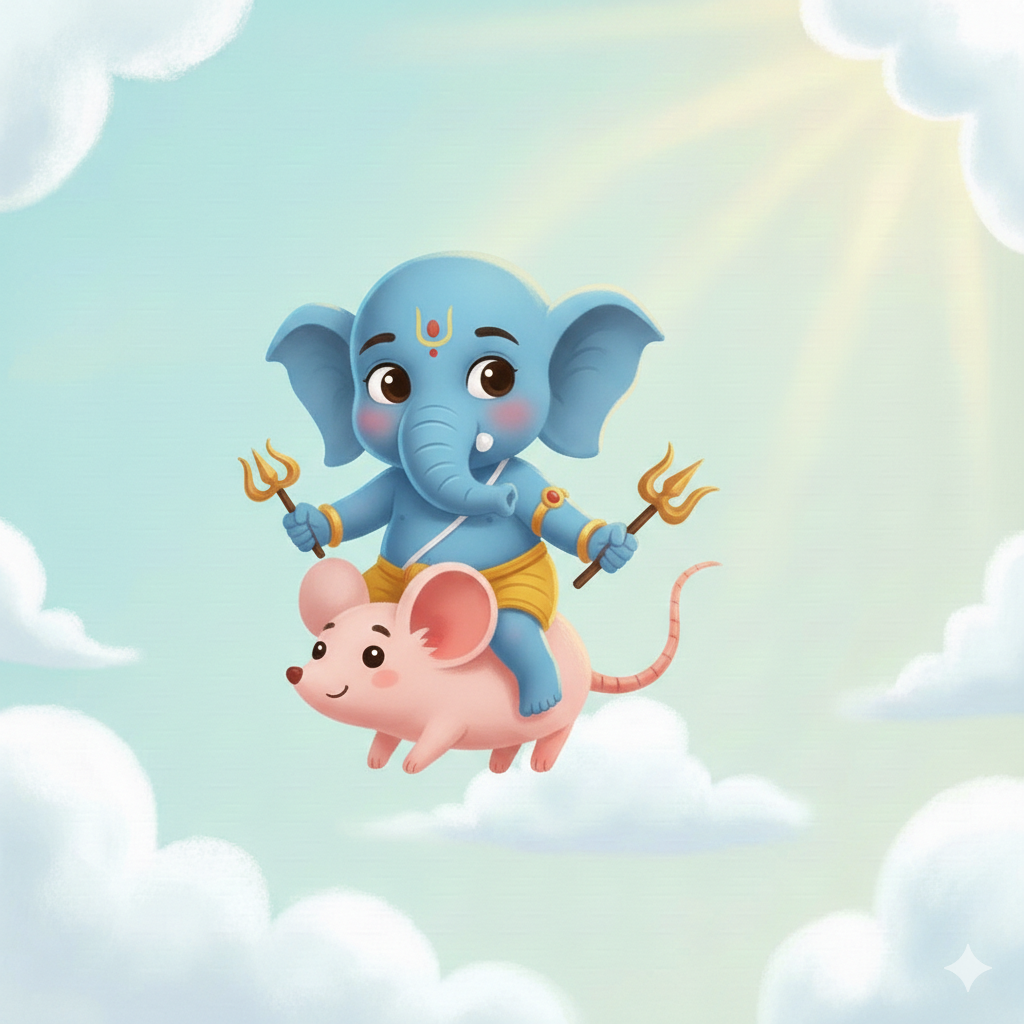
Ganesh (Ganesha, Vinayaka) is the elephant-headed god of wisdom, beginnings, and the remover of obstacles. He is the son of Shiva and Parvati and is invoked at the start of rituals, journeys, and new ventures. His vehicle is the mouse, and he is often shown with a broken tusk, modak (sweet), and the gesture of blessing. The eight temples of the Ashtavinayak in Maharashtra are among his most famous pilgrimage sites. Ganesh Chaturthi is the major festival celebrating his birth.
Birth of Ganesha
In the Shiva Purana, the birth of Ganesha is described as a divine act of Goddess Parvati’s will, soon after her marriage to Shiva. Desiring a loyal guard who would obey only her, Parvati created a handsome boy from the mala (divine paste) of her own body, breathed life into him, and instructed him to guard the entrance while she bathed.
When Shiva arrived and tried to enter, the boy—faithful to his mother’s command—blocked his path and even struck him with a stick. A fierce clash followed between Ganesha and Shiva’s ganas, and in the heat of the conflict the boy’s head was severed. Grief‑stricken, Parvati threatened to destroy the universe unless her son was restored.
To pacify her, Shiva ordered the devas to bring the head of the first living being they saw facing north. They returned with the head of a single‑tusked elephant, which was joined to the boy’s body. Shiva then revived him, naming him Ganapati, lord of all the ganas, and decreed that he would be honoured first in all rituals and auspicious beginnings.
Shlokas
Vakratunda Mahakaaya
Shloka (Sanskrit):
vakratuṇḍa mahākāya sūryakoṭi samaprabha
nirvighnaṃ kuru me deva sarva kāryeṣu sarvadā
Meaning: O Lord Ganesha, with the curved trunk and mighty form, whose radiance is like millions of suns, please remove all obstacles from the actions I wish to undertake, at all times.
Mooshika Vaahana Modhaka Hastha
Shloka (Sanskrit):
mūṣika vāhana modaka hasta
cāmara karṇa vilambita sūtra
vāmana rūpa mahēśvara putra
vighna vināyaka pāda namastē
Meaning: Salutations to Lord Vinayaka, son of Maheshwara, who rides the mouse, holds modak in his hand, whose ears are like fans, who wears a sacred thread and appears in a short form. We bow to his feet, the remover of obstacles.
Meaning: I bow to Lord Vighneshwara, son of Uma, who has the face of an elephant, is served by the hosts of beings, who enjoys the essence of kapittha and jambu fruits, and who removes sorrow and obstacles.
Mantra chant
Om Gan Ganpataye Namah
Mantra: Om Gan Ganpataye Namah (ॐ गं गणपतये नमः)
Chant this mantra to invoke Lord Ganesha’s blessings for auspicious beginnings and removal of obstacles.
Vallabham Gajananam / Lalitham Sadashivam
Mantra:
Vallabham gajananam ek dantham Lalitham sadashivam lalitham chandrashekharam
Chanting a Ganesha mantra 108 times daily is said to help remove obstacles and grant wishes when practised consistently over a period of time.
Hanuman
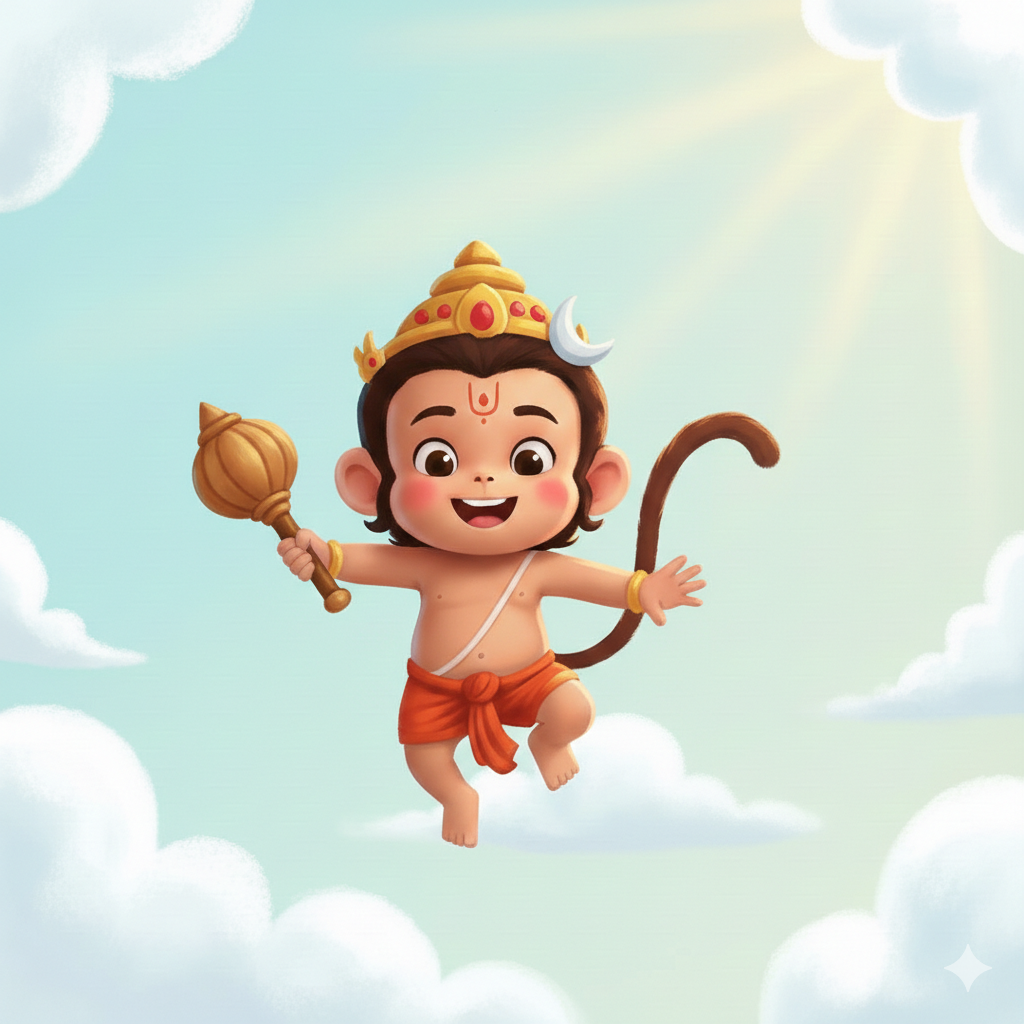
Hanuman (also known as Anjaneyar, Maruti, and Bajrang Bali) is the divine monkey god, a devotee of Rama and a central figure in the Ramayana. He embodies strength, devotion (bhakti), and selfless service. Hanuman is worshipped for courage, protection, and health, and is often invoked to overcome difficulties. He is depicted with a mace (gada) and the Sanjivani mountain, and is said to be celibate and ever devoted to Rama and Sita. Temples dedicated to Hanuman are found throughout India; Tuesdays and Saturdays are considered especially auspicious for his worship.
Story
As a child, Hanuman once saw the rising sun and mistook it for a bright, ripe fruit. Eager to eat it, he leapt into the sky and flew toward the sun. The gods were alarmed: the eclipse deity Rahu was at that moment approaching the sun for his monthly ritual, and the child’s speed and power seemed a threat to the cosmic order. Lord Indra struck Hanuman with his thunderbolt (vajra), and the boy fell to the earth, injuring his jaw (hanu). His father, the wind god Vayu, carried him away and withdrew his presence from the world, causing all beings to suffer. To appease Vayu, the gods blessed the child with boons: Indra gave him strength, Surya offered wisdom and mastery of the scriptures, and others granted him various powers. Thus the child who leapt at the sun grew into the mighty, devoted Hanuman of the Ramayana.
Bajrang Baan is a powerful hymn to Hanuman, often recited for protection and to remove obstacles. Below are the lyrics with English meanings.
Bajrang Baan — lyrics and meaning
Lyrics
Meaning
Om Sri Hanumate Namah nishchaya prema pratiti te binaya kare sanaman tehi ke karaja sakala shubha siddha karen hanuman
Those devotees who recite these verses with love and unwavering faith have all their beneficial desires fulfilled by Hanuman.
jaya hanumanta santa hitakari suni lijai prabhu araja hamari jana ke kaja bilamba na kijai atura dauri maha sukha dijai
Glory to Hanuman, the benefactor of saints. Please listen to our prayer. Do not delay in doing the work of your devotees. Please rush to do it and give us immense peace.
jaise kudi sindu wahi para surasa badana paithi vistara age ja-i lankini roka marehu lata ga-i suraloka
Come running just like when you leapt across the ocean, entered and then emerged from the expanded mouth of Surasa, and on landing in Lanka sent the demoness Lankini to the heavenly abode by kicking her when she tried to prevent you from entering the city.
jaya vibhishana ko sukha dinha sita nirakhi parama pada linha baga ujari sindhu maham bora ati atura yamakatura tora
In Lanka you gave pleasure to Vibhishan by meeting him and attained the supreme position of being loved by Sri Ram due to Sita's merciful benediction. Then you laid waste the Ashoka grove and dumped the trees in the ocean, symbolically breaking the knife of Yama, the God of Death.
akshay kumar ko mari sanghara luma lapeti lanka ko jara laha samana lanka jari gai jaya jaya dhuni surapura manha bhai
You killed Akshay Kumar (Ravana's son) and burnt Lanka with your tail. Lanka burned like lac and the heavens were filled with the sound of "Hail to Hanuman's glory".
aba bilamba kehi karana swami krpa karahu ura antarayami jaya jaya lakhana prana ke data atura ho-i dukha karahu nipata
Why are you delaying now my Lord; you know what resides in the minds of your devotees, so have mercy on me. Glory to you who restored the life of Lakshman. Quickly dispel my fears.
jai giridhara jai jai sukha sagara sura samuha samarata bata nagara om hanu hanu hanu hanumanta hatile bairihin maru vajra ke kile
Hail to you, holder of the mountain! You are an ocean of happiness, wisest amongst gods and the most skillful. O you of indomitable spirit, kill the enemies (lust, anger, greed) as if they were nailed by the strike of a thunderbolt.
gada vajra lai bairihin maro maharaja prabhu dasa ubaro omkara humkara mahavira dhavau vajra gada hanu vilamba na lavo
O Lord! Relieve your servant by hitting the enemies with your mace as if it were a thunderbolt. Saying the thundering sound of OM, challenge the enemies and crush them with your mace.
om hrim hrim hrim hanumanta kapisa om hum hum hum hanu ari ura shisha satya hohu hari shapata payake ramaduta dharu maru dhayake
O Hanuman, Lord of the Monkeys, I invoke you with the mantra Om hrim hrim hrim and Om hum hum hum. Strike the enemy in the chest and head. I swear by the name of Hari that all that I say is the truth. O messenger of Sri Ram, rush to attack the enemy at once.
jaya jaya jaya hanumanta agadha dukha pavata jana kehi aparadha puja japa tapa nema achara nahin janata haum dasa tumhara
Glory to you, o fathomless Hanuman! Due to which offence is your devotee suffering so much? This servant of yours knows nothing of worship, sacred mantras, penance, or the discipline of rituals and virtuous acts.
bana upavana maga giri griha mahin tumhare bala ham darapata nahin panya paraum kara jori manavaum yahi avasara aba kehi gohravaum
Relying on your strength, I have no fear anywhere – whether in the forest, garden, mountains, on the road, or in the house. I fall at your feet and entreat you with folded hands. For whom else shall I call at this hour?
jaya anjani kumara balavanta shankara suvana bira hanumanta badana karala kala kula ghalaka rama sahaya sada pratipalaka
Hail Hanuman! All-powerful son of Anjani and brave son of Shiva. You have a fierce and terrifying form and are the slayer of even the God of Death's minions. You are always by the side of Sri Ram and are the benefactor of all.
bhuta, preta, pisacha, nisachara agni baitala kala mari mara inhen maru tohi shapatha rama ki rakhu natha maryada nama ki
Slay all evil spirits: ghosts, spirits, hobgoblins, demons, fire, vampires, calamities, and epidemics. Kill all of them in the name of Lord Sri Ram thereby maintaining the sanctity and truth of the holy name.
janakasuta hari dasa kahavo taki shapata bilamba na lavo jaya jaya jaya dhuni hota akasha sumirata hota dusaha dukha nasha
You are the servant of Sri Ram and Mother Sita. I implore you in their names – make no delay. The sky is reverberating with the sound of your glories, the mere remembrance of which dispels all sorrows.
charana sharana kara jori manavaum yahi avasara aba kehi goharavaum uthu uthu chalu tohi rama doha-i panya paraum kara jori mana-i
I have come to take refuge at your feet. I plead with you; who else shall I call for help in this time of urgent need? Get up, get up, come along! I urge you with folded hands to swing into action.
om cham cham cham cham chapala chalanta om hanu hanu hanu hanu hanumanta om han han hanka deta kapi chanchal om sam sam sahami parane khaladal
I implore you O nimble-footed Hanuman with the call of Om cham cham cham cham and Om hanu hanu hanu hanu. Strike swiftly like lightning! O Hanuman, you are swift. Whenever the monkeys roar, the crowd of evil-doers flee in terror.
apane jana ko turata ubaro sumirata hoya ananda hamaro yahi bajarang bana jehi mare tahi kaho phir kauna ubare
Save this devotee of yours immediately. I get immense pleasure remembering you. Who can save one who is attacked with the arrow of Bajrang Baan (literally an arrow as strong as a thunderbolt)?
pata karai bajarang bana ki hanumata raksha karaim prana ki yaha bajarang bana jo japai tehi te bhuta preta saba kampai
Those who recite these verses of Bajrang Baan are protected for life by Hanuman. Even ghosts and evil spirits tremble out of fear of those who chant this Bajrang Baan.
dhupa dey aru japai hamesha take tana nahin rahai kalesha
Those who wave incense sticks in front of you and chant your holy name are always free from bodily torments of all kinds.
prema pratitihi kapi bhajai sada dharai ura dhyan tehi ke karaja sakala shubha siddha karai hanuman
Those who chant Hanuman's holy name with faith, devotion, and love and always remember him in their hearts are sure to have all their desires fulfilled by Hanuman.
Meaning: Strength of mind, courage, freedom from laziness, skillfulness in speech—these come from the contemplation on Hanuman.
A Sadhya Sadhaka Swamin
Shloka (Sanskrit):
a sādhyam sādhaka svāmin asādhyam tava kiṃ vada rāma dūta kṛpā sindho mat kāryam sādhaya prabho
Meaning to be added.
Ekadashi Hanuman Kavacham
Ekadashi Hanuman Kavacham — lyrics and meaning
Lyrics and meaning to be added.
Mantra chant
Om Hanumate Namah
Mantra: Om Hanumate Namah (ॐ हनुमते नमः)
Chant this mantra with devotion for Hanuman’s blessings and protection.
Surya (Sun)
Surya is the visible solar deity in Hindu tradition and is revered as the source of light, vitality, health, rhythm, and clarity. In the Vedic and epic tradition, Surya is honored as a universal witness and life-giver, and his worship is central in Saurism. Devotees pray to Surya for strength, discipline, healing, and steady intellect.
Gayatri Mantra
Om Bhur Bhuvah Svah
Mantra (Sanskrit):
Om Bhur Bhuvah Svah
Tat Savitur Varenyam
Bhargo Devasya Dheemahi
Dhiyo Yo Nah Prachodayat
Meaning: We meditate upon the divine radiance of Savita (the solar source). May that light illumine and guide our intellect.
Aditya Hrudaya Stotram
A celebrated Surya hymn from the Ramayana, taught by Sage Agastya to Rama before the decisive battle with Ravana.