Story 1 – Birth of Hanuman

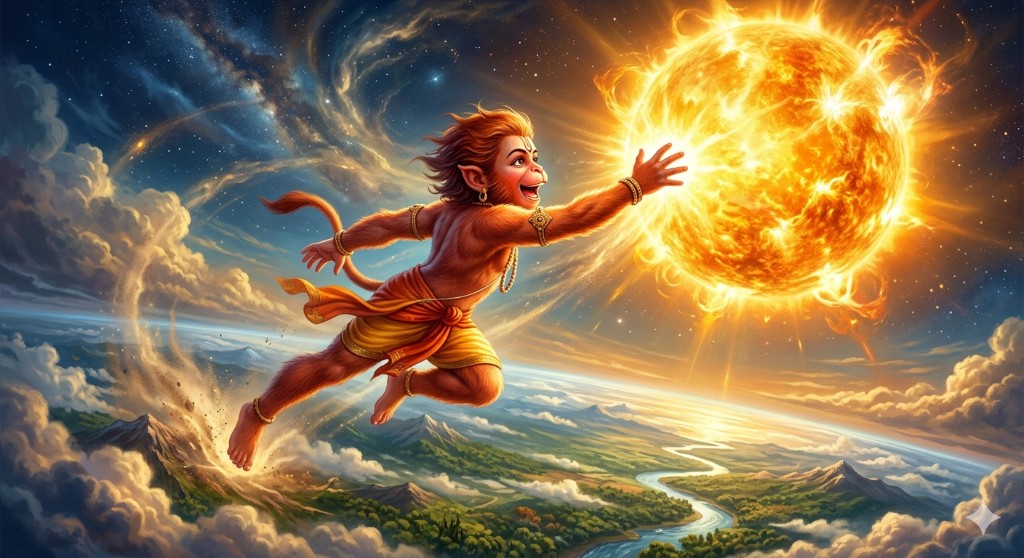
Young Hanuman leaping toward the sun, thinking it is a ripe fruit

As a child, Hanuman once saw the rising sun and mistook it for a bright, ripe fruit. Eager to eat it, he leapt into the sky and flew toward the sun. The gods were alarmed: the eclipse deity Rahu was at that moment approaching the sun for his monthly ritual, and the child’s speed and power seemed a threat to the cosmic order. Lord Indra struck Hanuman with his thunderbolt (vajra), and the boy fell to the earth, injuring his jaw (hanu). His father, the wind god Vayu, carried him away and withdrew his presence from the world, causing all beings to suffer. To appease Vayu, the gods blessed the child with boons: Indra gave him strength, Surya offered wisdom and mastery of the scriptures, and others granted him various powers. Thus the child who leapt at the sun grew into the mighty, devoted Hanuman of the Ramayana.

Story 2 – Hanuman in Shiva Purana

In the Shiva Purana, specifically within the Shatrudra Samhita, Hanuman is revered as the eleventh incarnation (Avatar) of Lord Shiva. The text narrates a fascinating origin: when Lord Shiva saw the enchanting Mohini form of Lord Vishnu, his divine energy was released. With Shiva's consent, the Saptarishis (seven sages) gathered this potent energy and, through the medium of Vayu (the wind god), established it in the womb of Anjani. Thus, Hanuman was born as a manifestation of Shiva's own power to assist Lord Rama in his mission.

The Purana highlights his childhood feat of swallowing the Sun, his education under the Sun-god, and his pivotal role in the Ramayana—finding Sita, burning Lanka, and bringing the Sanjivani mountain to save Lakshmana. Beyond his physical prowess, the Shiva Purana emphasizes that Hanuman is Bhaktavatsala (affectionate to devotees) and that his worship removes all hurdles, diseases, and worldly problems. He is also credited with establishing the Mahakapishvara Linga, showing his deep devotion to the formless Shiva even while serving Rama.

Story 3 – Panchmukhi Hanuman saves Rama and Lakshmana

During the war in Lanka, when Ravana was being defeated, he turned to his brother Ahiravana, the mighty king of Patal Lok, to change the course of battle. Ahiravana had received a boon from Lord Brahma that he could only be slain if five different lamps placed in five directions were extinguished at the same instant. Confident in this boon, he prepared a secret plan to capture Rama and Lakshmana.

Vibhishana warned Rama about Ahiravana, and Hanuman was posted as the vigilant guardian outside the brothers’ chamber. Ahiravana tried many times to enter but failed. At last, he disguised himself as Vibhishana, slipped past Hanuman, and kidnapped the sleeping Rama and Lakshmana, taking them down to Patal Lok as a sacrifice.

Realising what had happened, Hanuman descended to Patal Lok in search of them. Learning of the boon that protected Ahiravana, Hanuman assumed the formidable Panchmukhi form, manifesting five faces at once to look in all directions. With this five-faced form he blew out the five lamps simultaneously, breaking the boon’s protection, and then slew Ahiravana. In this way, Panchmukhi Hanuman saved Rama and Lakshmana and ensured the victory of dharma.
Stories of Hanuman – Birth and Legends | Temples & Traditions

Story 1 – Birth of Hanuman

Young Hanuman leaping toward the sun, thinking it is a ripe fruit

As a child, Hanuman once saw the rising sun and mistook it for a bright, ripe fruit. Eager to eat it, he leapt into the sky and flew toward the sun. The gods were alarmed: the eclipse deity Rahu was at that moment approaching the sun for his monthly ritual, and the child’s speed and power seemed a threat to the cosmic order. Lord Indra struck Hanuman with his thunderbolt (vajra), and the boy fell to the earth, injuring his jaw (hanu). His father, the wind god Vayu, carried him away and withdrew his presence from the world, causing all beings to suffer. To appease Vayu, the gods blessed the child with boons: Indra gave him strength, Surya offered wisdom and mastery of the scriptures, and others granted him various powers. Thus the child who leapt at the sun grew into the mighty, devoted Hanuman of the Ramayana.

Story 2 – Hanuman in Shiva Purana

In the Shiva Purana, specifically within the Shatrudra Samhita, Hanuman is revered as the eleventh incarnation (Avatar) of Lord Shiva. The text narrates a fascinating origin: when Lord Shiva saw the enchanting Mohini form of Lord Vishnu, his divine energy was released. With Shiva's consent, the Saptarishis (seven sages) gathered this potent energy and, through the medium of Vayu (the wind god), established it in the womb of Anjani. Thus, Hanuman was born as a manifestation of Shiva's own power to assist Lord Rama in his mission.

The Purana highlights his childhood feat of swallowing the Sun, his education under the Sun-god, and his pivotal role in the Ramayana—finding Sita, burning Lanka, and bringing the Sanjivani mountain to save Lakshmana. Beyond his physical prowess, the Shiva Purana emphasizes that Hanuman is Bhaktavatsala (affectionate to devotees) and that his worship removes all hurdles, diseases, and worldly problems. He is also credited with establishing the Mahakapishvara Linga, showing his deep devotion to the formless Shiva even while serving Rama.

Story 3 – Panchmukhi Hanuman saves Rama and Lakshmana

During the war in Lanka, when Ravana was being defeated, he turned to his brother Ahiravana, the mighty king of Patal Lok, to change the course of battle. Ahiravana had received a boon from Lord Brahma that he could only be slain if five different lamps placed in five directions were extinguished at the same instant. Confident in this boon, he prepared a secret plan to capture Rama and Lakshmana.

Vibhishana warned Rama about Ahiravana, and Hanuman was posted as the vigilant guardian outside the brothers’ chamber. Ahiravana tried many times to enter but failed. At last, he disguised himself as Vibhishana, slipped past Hanuman, and kidnapped the sleeping Rama and Lakshmana, taking them down to Patal Lok as a sacrifice.

Realising what had happened, Hanuman descended to Patal Lok in search of them. Learning of the boon that protected Ahiravana, Hanuman assumed the formidable Panchmukhi form, manifesting five faces at once to look in all directions. With this five-faced form he blew out the five lamps simultaneously, breaking the boon’s protection, and then slew Ahiravana. In this way, Panchmukhi Hanuman saved Rama and Lakshmana and ensured the victory of dharma.

Stories of Hanuman – Birth and Legends | Temples & Traditions

Hanuman’s life is filled with inspiring stories that show his strength, devotion, humility, and deep connection to both Rama and Shiva. This page gathers some of those stories in one place so they can be read slowly and reflected upon.

Story 1 – Birth of Hanuman

As a child, Hanuman once saw the rising sun and mistook it for a bright, ripe fruit. Eager to eat it, he leapt into the sky and flew toward the sun. The gods were alarmed: the eclipse deity Rahu was at that moment approaching the sun for his monthly ritual, and the child’s speed and power seemed a threat to the cosmic order. Lord Indra struck Hanuman with his thunderbolt (vajra), and the boy fell to the earth, injuring his jaw (hanu). His father, the wind god Vayu, carried him away and withdrew his presence from the world, causing all beings to suffer. To appease Vayu, the gods blessed the child with boons: Indra gave him strength, Surya offered wisdom and mastery of the scriptures, and others granted him various powers. Thus the child who leapt at the sun grew into the mighty, devoted Hanuman of the Ramayana.

Story 2 – Hanuman in the Shiva Purana

In the Shiva Purana, specifically within the Shatrudra Samhita, Hanuman is revered as the eleventh incarnation (Avatar) of Lord Shiva. The text narrates a fascinating origin: when Lord Shiva saw the enchanting Mohini form of Lord Vishnu, his divine energy was released. With Shiva's consent, the Saptarishis (seven sages) gathered this potent energy and, through the medium of Vayu (the wind god), established it in the womb of Anjani. Thus, Hanuman was born as a manifestation of Shiva's own power to assist Lord Rama in his mission.

The Purana highlights his childhood feat of swallowing the Sun, his education under the Sun-god, and his pivotal role in the Ramayana—finding Sita, burning Lanka, and bringing the Sanjivani mountain to save Lakshmana. Beyond his physical prowess, the Shiva Purana emphasizes that Hanuman is Bhaktavatsala (affectionate to devotees) and that his worship removes all hurdles, diseases, and worldly problems. He is also credited with establishing the Mahakapishvara Linga, showing his deep devotion to the formless Shiva even while serving Rama.