Listen to This Guide: Diwali (Deepavali) – The Festival of Lights
~6 min • Neural Audio1. Spiritual Essence & Etymology of Deepavali
Diwali, known in classical Sanskrit and across South India as Deepavali (दीपावली — Deepa meaning “clay lamp or light” and Avali meaning “a continuous row or series”), is one of the most sacred and joyous pan-Indian festivals in Sanatana Dharma (Hinduism). Observed during the transition from the lunar month of Ashwin to Kartika (October–November), both names—Diwali and Deepavali—celebrate the triumph of spiritual wisdom (Jnana) over ignorance (Avidya), righteousness (Dharma) over tyranny, and inner radiance over darkness.
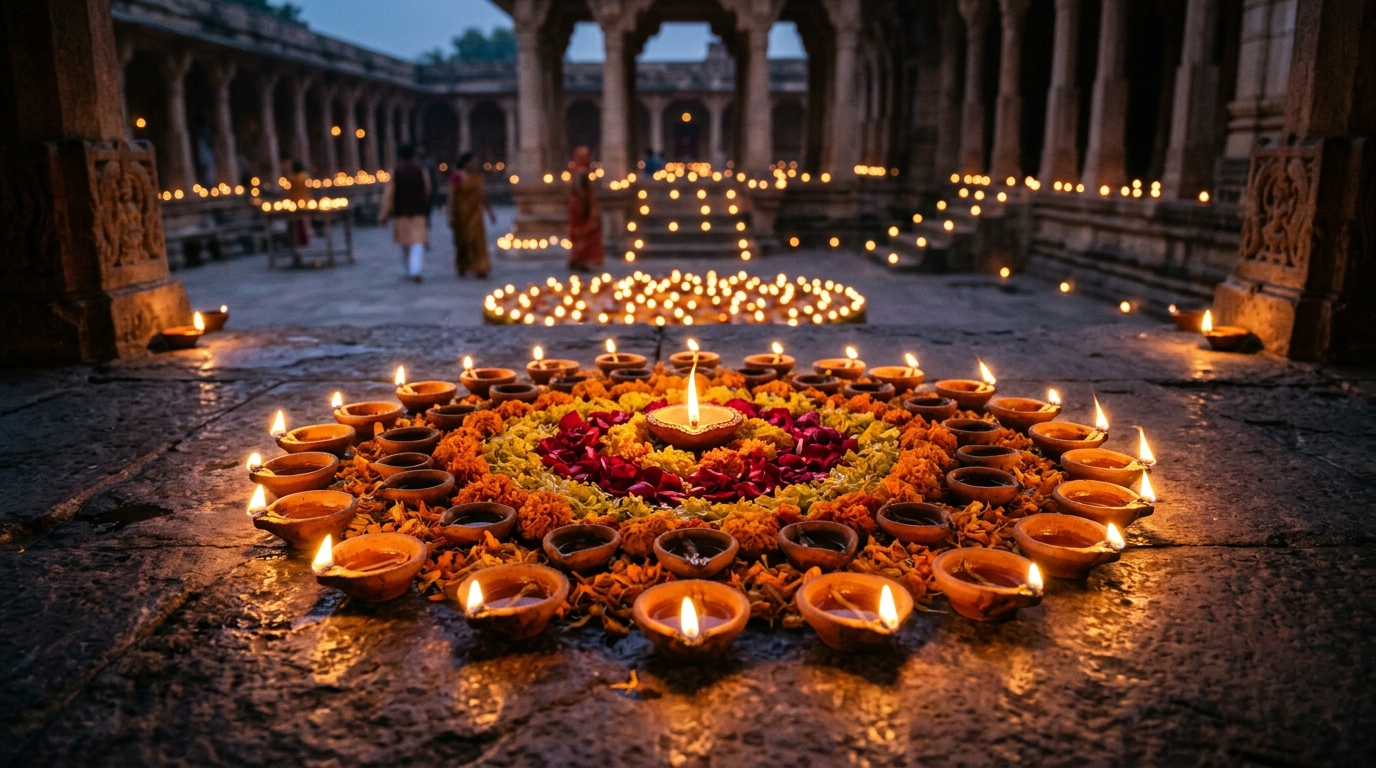
Mentioned in the Puranas—specifically the Padma Purana and the Skanda Purana—the clay lamp (diya) is a profound metaphor for human existence: the earthen clay bowl represents the physical body, the oil or ghee represents accumulated karmic tendencies and worldly attachments (vasanas), and the cotton wick represents the individual ego. When lit by the flame of spiritual knowledge, the oil and ego are steadily consumed, radiating pure light to everyone around.
Sri Rama’s Homecoming: The Valmiki Ramayana Journey
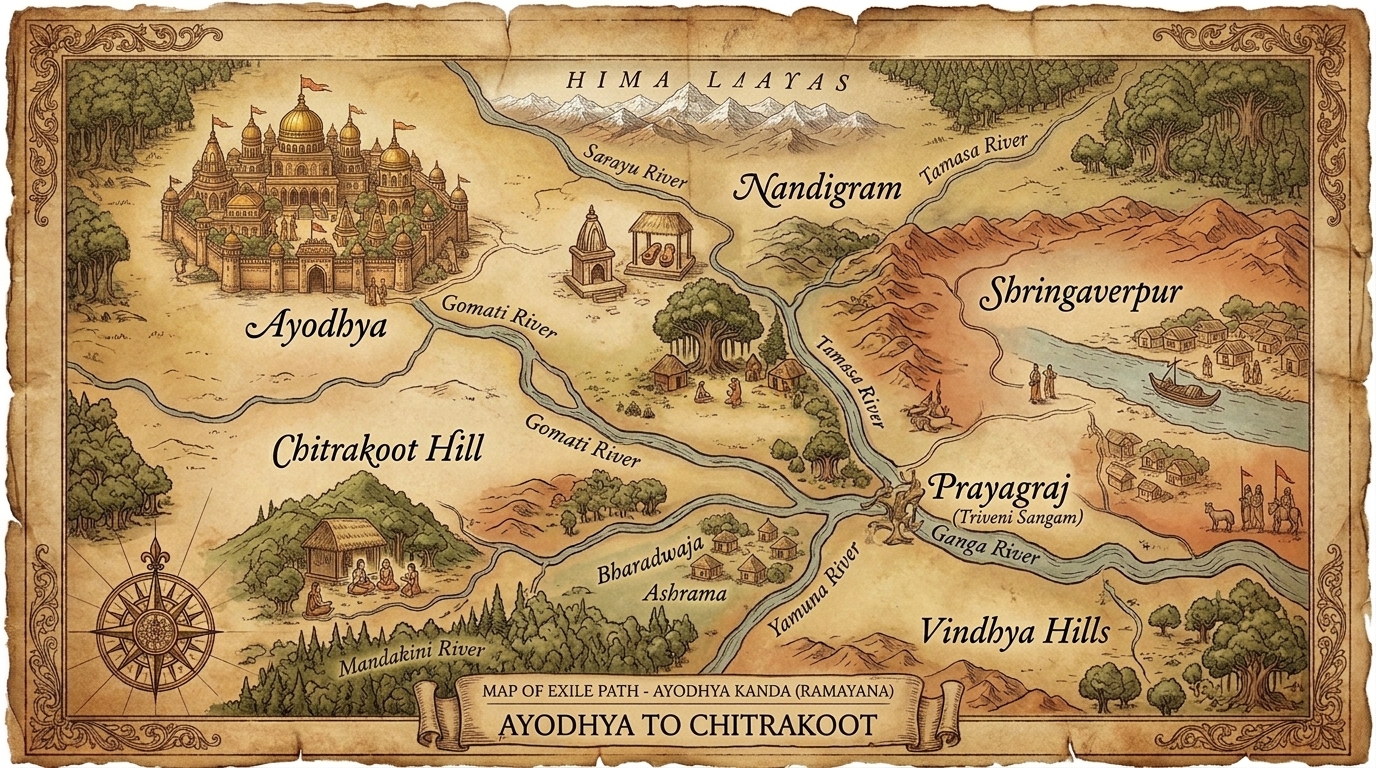
The celebrated lighting of millions of earthen lamps across Ayodhya marks the triumphant return of Lord Sri Rama, Devi Sita, and Lakshmana aboard the celestial Pushpaka Vimana following their 14-year exile and victory in Lanka. Experience the entire sacred journey from royal Ayodhya to Lanka in our interactive studio.
2. The Five Sacred Days of Diwali (Deepavali)
Across much of India, Diwali (or Deepavali) unfolds as a five-day sacred observance (Pancha-Parva), where each lunar day (tithi) honors a distinct deity, cosmic event, and household ritual:
| Day & Lunar Tithi | Festival Name | Presiding Deities | Core Significance & Rituals |
|---|---|---|---|
| Day 1 Trayodashi (13th dark lunar day) |
Dhanteras (Dhantrayodashi) |
Lord Dhanvantari, Goddess Lakshmi & Lord Yama | Emergence of Dhanvantari with the pot of Amrita; purchasing gold, silver, or utensils; lighting the Yama Deepam facing south. |
| Day 2 Chaturdashi (14th dark lunar day) |
Naraka Chaturdashi (Choti Diwali / South India Deepavali) |
Lord Krishna, Devi Satyabhama, Hanuman & Kali | Victory over the demon Narakasura; early dawn Abhyanga Snan (sesame oil bath before sunrise); primary Deepavali celebration across South India. |
| Day 3 Amavasya (New Moon night) |
Main Diwali / Deepavali (Lakshmi Puja / Kali Puja) |
Goddess Mahalakshmi, Lord Ganesha, Lord Rama & Maa Kali | Lord Rama’s return to Ayodhya; Lakshmi’s emergence from Samudra Manthan; evening Lakshmi-Ganesha Puja; midnight Kali Puja in East India. |
| Day 4 Pratipada (1st bright lunar day) |
Govardhan Puja (Annakut / Bali Pratipada) |
Lord Krishna (Govardhanagiridhari) & King Mahabali | Krishna lifting Govardhan Hill to shelter Vrindavan from Indra’s storm; offering a mountain of 56 food items (Chappan Bhog); Vikram Samvat New Year. |
| Day 5 Dwitiya (2nd bright lunar day) |
Bhai Dooj (Yama Dwitiya / Bhau Beej) |
Lord Yama & Goddess Yamuna | Yamuna welcoming her brother Yama with a protective tilak and feast; sisters praying for their brothers’ longevity and dharma. |
Detailed Significance of Each Day
- Day 1 – Dhanteras (Worship of Health & Prosperity): According to the Puranas, during the churning of the Cosmic Ocean (Samudra Manthan), Lord Dhanvantari—an incarnation of Lord Vishnu and father of Ayurveda—rose from the waters holding a golden chalice of Amrita (nectar of immortality). Devotees pray for physical health alongside material prosperity. At dusk, families light the Yama Deepam (a four-wick or single sesame/mustard oil lamp placed outside the main threshold facing South) to propitiate Yama, the Lord of Death, seeking protection from untimely death (Apamrityu).
- Day 2 – Naraka Chaturdashi (South Indian Deepavali & Choti Diwali): The tyrannical demon king Narakasura had stolen the earrings of Mother Aditi and imprisoned 16,000 princesses. Aided by His consort Satyabhama (an incarnation of Bhudevi), Lord Krishna vanquished Narakasura just before dawn. Before dying, Narakasura requested that the day be celebrated as Deepavali with light and joy rather than mourning. Taking a ritual bath with warm sesame oil (Abhyanga Snan) and herbal paste (Ubtan) before sunrise during Arunodaya is declared in the scriptures to carry the merit of bathing in the holy Ganges (“Taile Lakṣmīḥ Jale Gaṅgā” — Lakshmi resides in sesame oil, and Ganga resides in water on this dawn). In Gujarat and Rajasthan, the evening of Chaturdashi is also observed as Kali Chaudas / Roop Chaudas, with special worship offered to Lord Hanuman and recitation of the Hanuman Chalisa for protection from negative forces.
- Day 3 – Main Diwali & Lakshmi Puja: On the darkest new moon night of Kartika Amavasya, the citizens of Ayodhya lit millions of earthen rows of lamps (Deepavali) to welcome Lord Rama, Devi Sita, Lakshmana, and Hanuman returning after 14 years of exile and the defeat of Ravana, as chronicled in the Valmiki Ramayana. It is also the sacred night Goddess Mahalakshmi emerged from the Milky Ocean and chose Lord Vishnu as Her eternal consort.
- Day 4 – Govardhan Puja & Bali Pratipada: In North India, temples construct a symbolic hill of sacred food offerings (Annakut) commemorating how young Krishna lifted Mount Govardhan on His little finger for seven days to humble Indra’s pride. In Maharashtra, Karnataka, and Tamil Nadu, this day is celebrated as Bali Padyami (Bali Pratipada), honoring the noble demon-king Mahabali, whom Lord Vamana (the fifth Dashavatar of Vishnu) blessed to visit his people once a year.
- Day 5 – Bhai Dooj (Yama Dwitiya): When Lord Yama visited his sister Yami (the river goddess Yamuna) on the second lunar day of Shukla Paksha, she applied an auspicious tilak on his forehead and served him a loving meal. Pleased, Yama proclaimed that any brother who receives a tilak from his sister on this day would be freed from the fear of Yama and blessed with long life.
3. Diwali Lakshmi-Ganesha Puja at Home & Sacred Mantras
Why Are Lord Ganesha and Goddess Lakshmi Worshipped Together on Diwali?
While Goddess Lakshmi is the eternal consort of Lord Vishnu, on Diwali evening she is always worshipped alongside Lord Ganesha (revered across shrines such as the Ashtavinayak temples). Two primary philosophical and Puranic traditions explain this pairing:
- Wealth Guided by Wisdom: Goddess Mahalakshmi represents Artha (wealth, abundance, and material resources), while Lord Ganesha represents Buddhi and Viveka (wisdom, discernment, and auspicious restraint). Without wisdom, sudden wealth breeds arrogance and restlessness; when guided by Ganesha’s intellect, prosperity becomes a vehicle for dharma and family harmony.
- Vighnaharta First: In every Vedic ritual, Ganesha is invoked first to clear unseen obstacles (Vighnas) from the household before inviting Mahalakshmi to dwell permanently. During placement on the altar, Ganesha is always placed to the left of Goddess Lakshmi (so Lakshmi stands to the right of Ganesha, the traditional maternal blessing position).
Simple Step-by-Step Home Puja Vidhi (Pradosha Kaal)
Diwali Lakshmi Puja is best performed during Pradosha Kaal (the two-hour window beginning at sunset) when the fixed Vedic zodiac ascendant Vrishabha Lagna (Taurus) prevails, symbolizing lasting stability (Sthira Lakshmi):
- Altar Preparation (Sthapana): Clean the puja area thoroughly, draw a small floral or rice-flour rangoli (Alpana / Kolam), and spread a clean red or yellow cloth over a raised wooden platform (Chowki).
- Kalash & Deities: Place a handful of unbroken rice grains (Akshata) in the center and set a copper or silver Kalash filled with water, a betel nut, a coin, and five mango leaves crowned with a coconut. Place the idols or images of Lord Ganesha and Goddess Lakshmi beside it.
- Lighting the Main Diya: Light a pure cow-ghee diya and a sesame-oil diya before the deities while chanting the Deepam Jyoti mantra below.
- Shodashopachara Offerings: Offer turmeric, kumkum, sandalwood paste (chandan), lotus flowers or red roses, unbroken sacred rice, coins/account books, and traditional Deepavali naivedyam offerings: Kheel-Batasha (parched rice and sugar drops), coriander seeds with jaggery (Dhaniya-Gud, a cherished symbol of wealth preservation), and homemade sweets.
- Recitation & Aarti: Chant the Ganesha stotram, Sri Suktam, Mahalakshmi Ashtakam, or Kanakadhara Stotram, and conclude with the family singing the Lakshmi Aarti.
Sacred Mantras to Chant on Diwali (Deepavali)
1. Deepam Jyoti Mantra (Chanted When Lighting the Diya)
शुभं करोति कल्याणमारोग्यं धनसम्पदः ।
शत्रुबुद्धिविनाशाय दीपज्योतिर्नमोऽस्तुते ॥
दीपज्योतिः परब्रह्म दीपज्योतिर्जनार्दनः ।
दीपो हरतु मे पापं सन्ध्यादीप नमोऽस्तुते ॥
Śubhaṃ Karoti Kalyāṇam-Ārogyaṃ Dhana-Sampadaḥ |
Śatru-Buddhi-Vināśāya Dīpa-Jyotir-Namo'stute ||
Dīpa-Jyotiḥ Para-Brahma Dīpa-Jyotir-Janārdanaḥ |
Dīpo Haratu Me Pāpaṃ Sandhyā-Dīpa Namo'stute ||
Meaning: “Salutations to the light of the sacred lamp, which brings auspiciousness, welfare, good health, and abundance of wealth, and destroys all hostile and negative thoughts. The light of the lamp is Supreme Brahman; the light of the lamp is Lord Janardana (Vishnu). May this sacred evening lamp remove all my sins; salutations to Thee.”
2. Mahalakshmi Moola Mantra
ॐ श्रीं ह्रीं श्रीं कमले कमलालये प्रसीद प्रसीद
ॐ श्रीं ह्रीं श्रीं महालक्ष्म्यै नमः ॥
Om Śrīṃ Hrīṃ Śrīṃ Kamale Kamalālaye Prasīda Prasīda
Om Śrīṃ Hrīṃ Śrīṃ Mahālakṣmyai Namaḥ ||
Meaning: “Salutations to Goddess Mahalakshmi, who abides upon the sacred lotus. Be gracious unto us and bless our home with purity, fortune, and spiritual grace.”
Traditional Note on Moola Mantras: In Vedic and Agamic tradition, Moola Mantras containing potent seed syllables (Bija Aksharas such as Śrīṃ and Hrīṃ) are most effective and spiritually safe when received through formal initiation (Guru Upadesha / Diksha) from a qualified Guru. Devotees who have not received formal mantra initiation may lovingly chant simple Nama Mantras such as “Om श्री महालक्ष्म्यै नमः (Om Śrī Mahālakṣmyai Namaḥ)” or devotional hymns like the Mahalakshmi Ashtakam during Deepavali puja.
4. Deepavali & Diwali Across North, South, East & West India
While the unifying thread of Deepavali is sacred light, its regional observance across India highlights diverse scriptural traditions:
- South India (Tamil Nadu, Karnataka, Andhra Pradesh & Telangana): Across South India, the festival is universally known as Deepavali and its primary celebration takes place at dawn on Naraka Chaturdashi (the day before Amavasya). Families wake before 4:30 AM (Brahma Muhurta), elders apply warm gingelly (sesame) oil to the crown of the head of every family member, and everyone takes a purifying bath. Neighbors greet one another with the joyous Tamil phrase, “Ganga Snanam Aacha?” (“Have you taken your sacred Ganga bath?”). Freshly purchased clothes (Puthu Thuni) are consecrated with a dot of turmeric before the altar, followed by a spoonful of Deepavali Legiyam (Marundhu)—an Ayurvedic digestive paste of dry ginger, pepper, cumin, jaggery, and ghee—before enjoying Adhirasam, Murukku, and Mysore Pak. Many Tamil households also observe Kedara Gowri Vratham (Deepavali Nombu) on Amavasya, honoring Lord Shiva and Parvati as Ardhanarishvara, and visit historic temples of Tamil Nadu and Divya Desam shrines.
- North & Central India (Uttar Pradesh, Delhi, Rajasthan, Madhya Pradesh, Punjab): Widely called Diwali, celebrations span all five days and peak on Kartika Amavasya evening with grand home and temple illuminations celebrating Lord Rama’s homecoming to Ayodhya, exchanging sweets, and worshipping Lakshmi and Ganesha.
- Western India (Gujarat & Maharashtra): In Gujarat, Diwali marks the conclusion of the financial year; merchants perform Chopda Pujan (consecrating new red ledger books with a Swastika and Shubh-Labh) and celebrate Bestu Varas (Vikram Samvat New Year) the next morning. In Maharashtra, Deepavali begins a day early on Vasu Baras (Govatsa Dwadashi), honoring mother cows and calves, and includes building miniature replicas of Chhatrapati Shivaji Maharaj’s hill forts (Diwali Killa).
- Eastern India (West Bengal, Odisha, Assam & Mithila): While earthen lamps (pradips) are lit across homes, Amavasya night is dedicated to the awe-inspiring worship of Goddess Kali (Shyama Puja / Dipannita Kali Puja) during midnight (Nishita Kaal). In Odisha, families also perform Bada Badua Daka, holding lit jute sticks skyward to honor and guide departed ancestors.
5. Sacred Temples Associated with Diwali & Deepotsav
Pilgrims from around the world visit India’s historic Hindu temples during Kartika month to witness breathtaking Diwali and Deepavali illuminations:
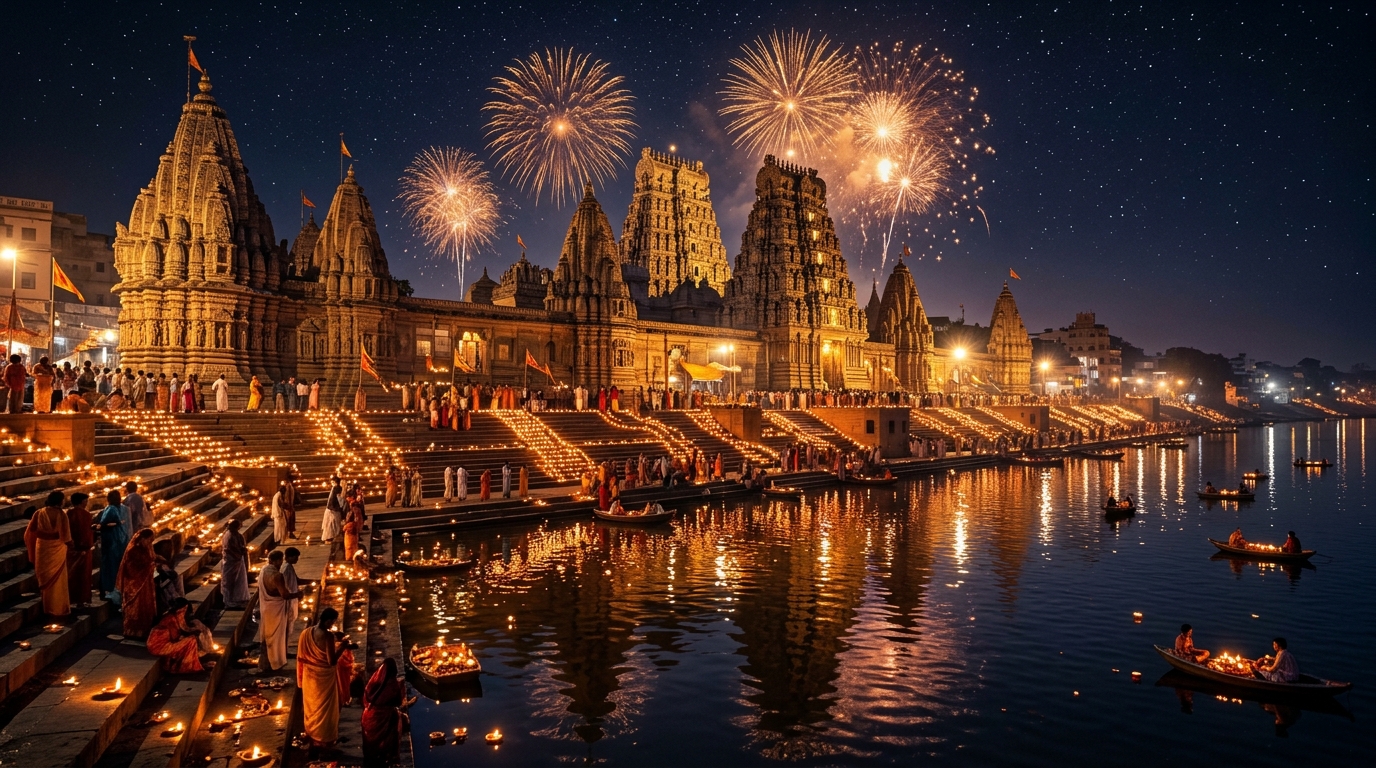
- Sri Ram Janmabhoomi Mandir, Ayodhya (Uttar Pradesh): The spiritual epicenter of North Indian Diwali. Every year on the eve of Diwali, Ayodhya hosts the world-renowned Deepotsav along Ram Ki Paidi and the banks of the sacred Sarayu River, lighting over 2.5 million earthen diyas to reenact the historic welcome of Lord Rama.
- Kashi Vishwanath Jyotirlinga & Dashashwamedh Ghat, Varanasi (Uttar Pradesh): Home to the revered Kashi Vishwanath Jyotirlinga. While Diwali night sees the ancient ghats of Varanasi glow with lamps, fifteen days later on Kartik Purnima (the full moon of Kartika), Kashi celebrates Dev Deepavali (“the Deepavali of the Gods”). According to the Shiva Purana, on this day Lord Shiva destroyed the three aerial cities of the demon Tripurasura, and the Devas descend to bathe in the Ganga and light millions of lamps across all 84 ghats.
- Sri Mahalakshmi (Ambabai) Temple, Kolhapur (Maharashtra): One of the revered Shakti Peetams where Goddess Mahalakshmi resides eternally. On Deepavali and Kartika nights, the ancient black-stone sanctum is illuminated with thousands of traditional oil lamps and midnight Maha Aarti.
- Ashtalakshmi Temple, Besant Nagar, Chennai (Tamil Nadu): Built on the shores of the Bay of Bengal in the architectural shape of the sacred syllable OM (Pranava), this multi-tiered temple enshrines all eight forms of Goddess Lakshmi (Adi, Dhanya, Dhairya, Gaja, Santana, Vijaya, Vidya, and Dhana Lakshmi) and draws thousands of devotees on South Indian Deepavali.
- Dakshineswar & Kalighat Kali Temples, Kolkata (West Bengal): Kalighat is one of the foremost Shakti Peetams. On Diwali Amavasya night, both historic shrines host grand Dipannita Kali Puja throughout the night, echoing the devotional legacy of Sri Ramakrishna Paramahansa.
- Sri Harmandir Sahib (Golden Temple), Amritsar (Punjab): Coinciding with Diwali, Sikhs celebrate Bandi Chhor Divas (commemorating Guru Hargobind Sahib Ji freeing 52 royal princes from Gwalior Fort), illuminating the Golden Temple and its sacred Amrit Sarovar with countless lamps and fireworks.
6. “Why Do We...” Diwali & Deepavali FAQ
How many diyas should we light on Diwali / Deepavali (significance of 13 diyas) and where to place them?
According to traditional Hindu almanacs, a household lights a minimum of 13 earthen diyas (or multiples of odd numbers such as 13, 21, 51, or 108) on Dhanteras and Deepavali night:
- First Diya (Yama Deepam): Placed outside the home near the entrance facing South on Dhanteras dusk for family longevity and protection.
- Second Diya (Akhanda Deepam): Lit with pure cow ghee in the home Puja altar before Goddess Lakshmi and Lord Ganesha.
- Third & Fourth Diyas: Placed on both sides of the main entrance threshold to welcome auspicious energy.
- Fifth Diya: Placed beside the sacred Tulsi (Holy Basil) plant in the courtyard or balcony.
- Sixth Diya: Placed under a sacred Peepal or Bel tree (or at a nearby temple).
- Seventh Diya: Placed in the kitchen near the stove and grain storage (Annapoorna corner).
- Eighth Diya: Placed near the household drinking water source (representing Varuna and Ganga).
- Ninth to Thirteenth Diyas: Placed on balconies, window sills, rooftops, staircases, and dark corners of the home so no space remains in darkness.
Which oil should be used for Deepavali diyas and which direction should the wick face?
Choice of Oil / Fuel:
- Pure Cow Ghee: Considered the most sattvic (pure) fuel; ideal for the main altar lamp placed directly in front of Goddess Lakshmi and Lord Ganesha.
- Sesame (Gingelly / Til) Oil: Highly auspicious for removing Navagraha (planetary) afflictions, clearing obstacles, and inviting prosperity throughout the home.
- Mustard (Sarson) Oil: Traditionally used for outdoor lamps, the Yama Deepam, and pacifying Saturn (Shani) and Kaala Bhairav.
Wick Direction (Vastu):
- East Direction: Bestows good health, mental peace, and harmony.
- North Direction: The direction of Lord Kubera and Goddess Lakshmi; ideal for inviting wealth, knowledge, and career growth.
- South Direction: Avoided for all regular puja lamps, and used only for the single outdoor Yama Deepam lit on Dhanteras evening to honor ancestors and Lord Yama.
Why do people buy a new broom (jhadu) and salt on Dhanteras?
In the Matsya Purana and traditional household lore, Goddess Lakshmi resides only where there is physical and moral cleanliness (Saucha). A new broom symbolizes sweeping away Alakshmi—the personification of poverty, sloth, debt, and discord—before Diwali night. Similarly, buying rock salt (Sendha Namak) on Dhanteras and mopping the floor with a pinch of salt water is believed to purify stagnant negative vibrations in the home.
Why are fireworks lit on Diwali (Deepavali) according to ancient Hindu scriptures?
Beyond festive joy, the custom of illuminating the night sky has deep roots in the Skanda Purana under the ritual of Ulka Daan (offering firebrands/torches in the sky). Departed ancestors (Pitrus) who descend to earth during Pitru Paksha (Mahalaya Amavasya) begin their return journey to the celestial realms on the dark moonless night of Kartika Amavasya. Lighting elevated sky-lamps, torches, and sparklers while chanting verses from the scriptures was traditionally performed to illuminate their path back to Pitru Loka.
Why do we draw Rangoli (Kolam) and footprints at the entrance on Deepavali?
Drawing geometric patterns (Rangoli, Kolam, or Alpana) with rice flour, turmeric, and vermilion at the threshold serves two purposes: spiritually, the symmetrical mandala acts as a sacred Yantra that harmonizes energy entering the home; ecologically, using rice flour feeds ants, birds, and tiny creatures (Bhuta Yajna — charity to all living beings). Small inward-pointing footprints (Lakshmi Pada) are drawn from the doorway toward the altar to symbolize Goddess Mahalakshmi stepping into the home.
7. Diwali & Deepavali 2026 Dates: North & South India Calendar
Because the Hindu lunar calendar (Panchangam) calculates festival dates based on when a lunar tithi prevails—at pre-dawn (Arunodaya) for South Indian Deepavali vs. evening sunset (Pradosha Kaal) for North Indian Diwali Lakshmi Puja—the two regions sometimes celebrate on consecutive days, and in some years on the exact same calendar day.
In 2026, Chaturdashi Tithi prevails at sunrise on Sunday, November 8, 2026 (until 11:27 AM IST), and Amavasya Tithi begins at 11:27 AM IST that same morning and prevails throughout the evening Pradosha Kaal. As a result, both South Indian Deepavali and North Indian Main Diwali fall on Sunday, November 8, 2026:
| 2026 Date | Festival / Observance | Region & Key Timings (IST) |
|---|---|---|
| Friday, November 6, 2026 | Dhanteras (Dhantrayodashi) & Yama Deepam | Pan-India: Auspicious day for purchasing gold, silver, utensils, and lighting the evening Yama Deepam. |
| Saturday, November 7, 2026 | Kali Chaudas / Hanuman Puja (Choti Diwali Eve) | West & North India: Evening worship of Lord Hanuman and Mahakali when Chaturdashi prevails at night. |
| Sunday, November 8, 2026 (Morning) | South India Deepavali (Naraka Chaturdashi) | South India (Tamil Nadu, Karnataka, Andhra, Telangana): Pre-dawn Abhyanga Snan (oil bath before sunrise), new clothes, sweets, and crackers as Chaturdashi lasts until 11:27 AM IST. |
| Sunday, November 8, 2026 (Evening) | North India Main Diwali (Lakshmi-Ganesha Puja & Kali Puja) | North, West & East India: Main Diwali evening Lakshmi Puja during Pradosha Kaal (5:31 PM – 8:09 PM IST); midnight Dipannita Kali Puja in Bengal and Eastern India. |
| Monday, November 9, 2026 | Kartika Amavasya Snan & Kedara Gowri Vratham (Nombu) | Tamil Nadu & Pan-India: Amavasya prevails at sunrise until 12:31 PM IST; many Tamil families observe Deepavali Amavasai Nombu / Kedara Gowri Vratham on this morning. |
| Tuesday, November 10, 2026 | Govardhan Puja, Annakut, Bali Padyami & Bestu Varas | North, West & South India: Govardhan Puja, Gujarati New Year (Bestu Varas), and Bali Pratipada across Maharashtra and Karnataka. |
| Wednesday, November 11, 2026 | Bhai Dooj (Yama Dwitiya / Bhau Beej) | Pan-India: Concluding day of the 5-day Diwali festival celebrating the bond between brothers and sisters. |