1. Spiritual Essence of Maha Shivaratri
While the 14th night of the dark fortnight (Krishna Paksha Chaturdashi) in every lunar month is observed as Masik Shivaratri, the Chaturdashi night falling in the month of Phalguna / Magha (Tamil month of Maasi, February–March) is revered across Sanatana Dharma as Maha Shivaratri—“the Great Night of Lord Shiva.”
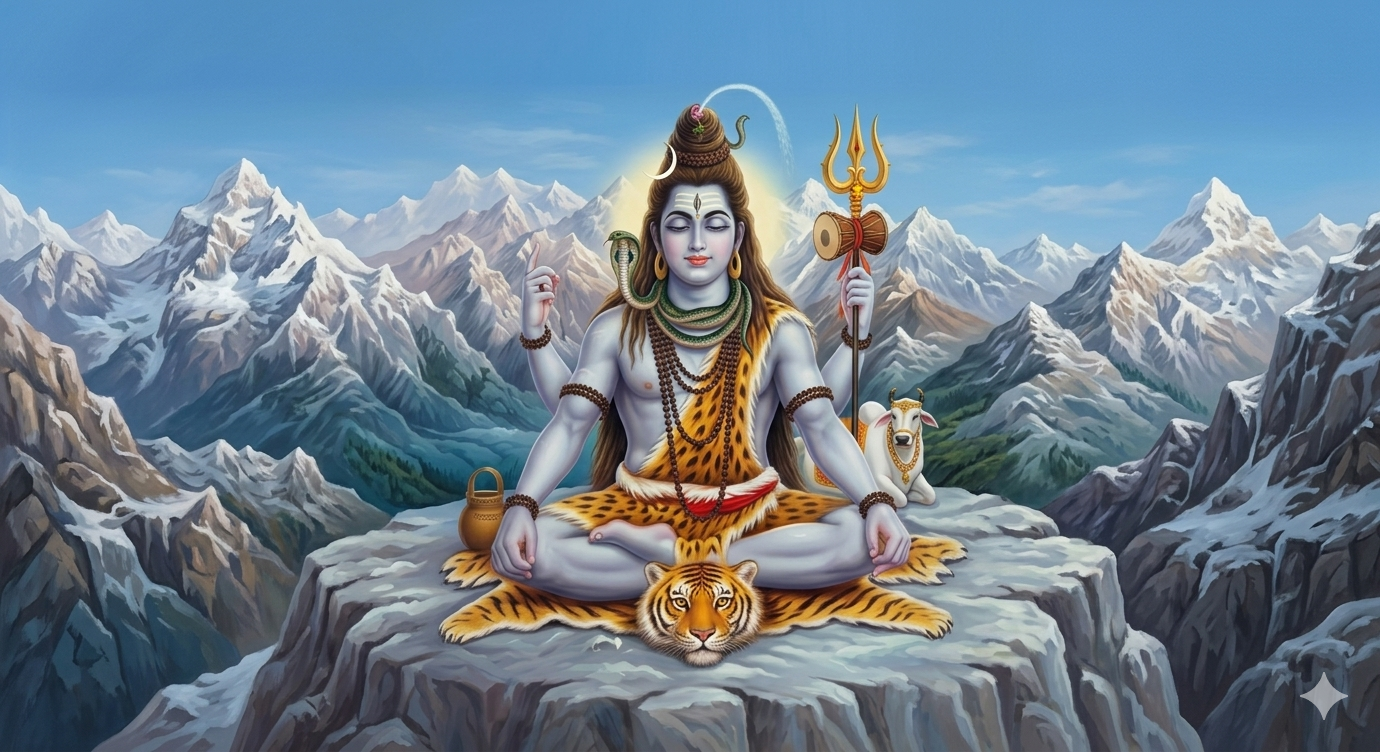
Unlike daytime festivals celebrated with outward merriment, Maha Shivaratri is an inward, contemplative night of Upavasa (fasting — literally “dwelling close to the Divine”), Jagarana (all-night vigil), and Abhishekam (sacred bathing of the Shiva Linga) accompanied by the primordial vibrations of Pranava (OM) and the Panchakshari Mantra (Om Namah Shivaya).
2. Four Sacred Legends from the Shiva Purana
According to the Vidyesvara Samhita and Kotirudra Samhita of the Shiva Purana, four monumental cosmic events converged on the night of Maha Shivaratri:
- Lingodbhava (First Manifestation of the Shiva Linga): At midnight (Nishita Kaal) on Phalguna Krishna Chaturdashi, the formless, infinite Parabrahman (Nishkala Shiva) manifested for the first time as a blazing, endless column of light—the Jyotirlinga—between Brahma and Vishnu, establishing the worship of the Shiva Linga as the bridge between the Formless and Form.
- Divine Marriage of Shiva and Parvati (Shiva-Shakti Vivaha): In the Himalayan traditions, Maha Shivaratri celebrates the sacred wedding night of Lord Shiva (pure consciousness, Purusha) and Goddess Parvati (creative cosmic energy, Prakriti / Shakti), as commemorated at shrines like Triyuginarayan and Thirumanancheri.
- Neelakantha Drinking the Halahala Poison: During the churning of the Milky Ocean (Samudra Manthan), when the deadly Halahala venom threatened to dissolve creation, Lord Shiva drank the poison and held it in His throat using the power of yoga while the Devas stayed awake all night singing His praises and pouring cooling waters over Him.
- The Story of Lubdhaka the Hunter (Kotirudra Samhita): A poor forest hunter named Lubdhaka (Gurudruha) was stranded up a Bilva (Bel) tree on the night of Shivaratri while waiting for game. Fasting by circumstance and staying awake through the night, he plucked Bilva leaves and dropped them onto a forgotten Shiva Linga beneath the tree, along with drops of water from his canteen. Though done unknowingly, his four-watch offering cleansed all his sins, and upon his death Lord Shiva blessed him as Guha and later elevated him to the celestial constellation Mrigashirsha.
3. The Four Prahar Abhishekam & Nishita Kaal
As prescribed in the Kotirudra Samhita of the Shiva Purana, the 12-hour night of Maha Shivaratri (from 6:00 PM sunset to 6:00 AM sunrise) is divided into four three-hour watches (Prahars / Yamas), each with a specific bathing substance, offering, and spiritual fruit:
| Prahar (Night Watch) | Approx. Window | Abhishekam Substance | Traditional Offering & Mantra | Spiritual Significance |
|---|---|---|---|---|
| 1st Prahar | 6:00 PM – 9:00 PM | Cow’s Milk (Dugdha) | Lotus flowers, unbroken rice, Om Hreem Ishanaya Namah | Purification of the mind and devotion (Bhakti). |
| 2nd Prahar | 9:00 PM – 12:00 AM | Curd / Yogurt (Dadhi) | Bilva leaves, tulsi/sesame, citron fruit, Om Hreem Aghoraya Namah | Health, prosperity, and emotional steadiness (Artha). |
| 3rd Prahar (Includes Nishita Kaal) | 12:00 AM – 3:00 AM | Pure Cow Ghee (Ghrita) | Bilva leaves, pomegranate, camphor aarti, Om Hreem Vamadevaya Namah | Lingodbhava hour: Inner wisdom and fulfillment of righteous desires (Dharma / Kama). |
| 4th Prahar | 3:00 AM – 6:00 AM | Honey (Madhu) & Gangajal | Blue lotus / white flowers, udad dal sweets, Om Hreem Sadyojataya Namah | Supreme liberation from the cycle of rebirth (Moksha). |
4. Sacred Mantras & Hymns to Chant on Shivaratri
Staying awake on Maha Shivaratri is traditionally accompanied by continuous recitation of the Vedic and Puranic Shiva hymns available with full Sanskrit, transliteration, meaning, and audio on our Shiva Bhajans & Chants page:
- Pranava (OM) & Panchakshari Mantra (Om Namah Shivaya): In the Kailasha Samhita and Vidyesvara Samhita of the Shiva Purana, Pranava (OM) is the bow and the Shiva Panchakshara Stotram (Na-Ma-Śi-Vā-Ya) is the heart of all Shiva worship.
- Sri Rudram (Namakam) & Chamakam: The 11 Anuvakas of the Krishna Yajurveda (listen and read Sri Rudram) chanted continuously during Rudrabhishekam.
- Mahamrityunjaya Mantra: The life-bestowing Rigvedic verse (Om Tryambakam Yajamahe...) for health, longevity, and fearlessness (read Mahamrityunjaya Mantra).
- Sri Shivashtakam, Rudrashtakam & Lingashtakam: Melodious stotrams praising Shiva’s cosmic form (read Shivashtakam & Rudrashtakam).
5. Significance of the Three-Leafed Bilva (Bel Patra)
No Maha Shivaratri puja is complete without offering the trifoliate Bilva leaf (Aegle marmelos) to the Shiva Linga (placed with the smooth surface facing down touching the Linga). According to the Bilvashtakam and the Shiva Purana, the three joined leaflets represent:
- The Three Eyes of Lord Shiva (Sun, Moon, and Cosmic Fire).
- The Three Gunas (Sattva, Rajas, and Tamas) surrendered at the feet of the Gunatita (One beyond Gunas).
- The Three Syllables of AUM (Pranava) — A-kāra, U-kāra, and Ma-kāra (explore the Mysticism of Pranava).
- The Trishula (Trident) and the three states of consciousness (Waking, Dream, and Deep Sleep).
6. Jyotirlinga & Panchabhoothasthalam Celebrations
Millions of devotees gather for all-night darshan across India’s great Shaiva pilgrimage circuits:
- The 12 Jyotirlinga Shrines: From Somnath (Gujarat) and Mahakaleshwar (Ujjain, famous for its 4:00 AM Bhasma Aarti) to Kashi Vishwanath (Varanasi), Omkareshwar (Madhya Pradesh), and Ramanathaswamy (Rameshwaram) — explore all 12 Jyotirlinga temples.
- The 5 Panchabhoothasthalam Temples: Honoring Shiva as the five elements of nature at Kanchipuram Ekambareswarar (Earth), Thiruvanaikaval Jambukeswarar (Water), Thiruvannamalai Arunachaleswarar (Fire), Srikalahasti (Air, famous for Rahu-Ketu and Vayu Linga abhishekam), and Chidambaram Nataraja (Space, hosting the Natyanjali classical dance festival) — explore Panchabhoothasthalam.
7. Maha Shivaratri 2027 Dates & Timings
| 2027 Date | Observance /Prahar | Key Timings (IST) |
|---|---|---|
| Saturday, March 6, 2027 | Maha Shivaratri (Day & Night Vigil) | Daytime fasting (Upavasa) and four-watch night Rudrabhishekam across all Shiva temples. |
| Night of March 6–7, 2027 (12:07 AM – 12:57 AM) | Nishita Kaal Puja (Lingodbhava Muhurat) | Most auspicious midnight window when Lord Shiva manifested as the infinite Pillar of Light. |
| Sunday, March 7, 2027 (Morning) | Shivaratri Parana (Breaking the Fast) | Concluding morning prayers and breaking the fast after sunrise before Chaturdashi Tithi ends. |
8. Frequently Asked Questions
When is Maha Shivaratri in 2027?
Maha Shivaratri 2027 falls on Saturday, March 6, 2027, with the midnight Nishita Kaal (Lingodbhava) puja taking place between 12:07 AM and 12:57 AM on the night of March 6–7, 2027.
Which items should NOT be offered to the Shiva Linga on Maha Shivaratri?
According to the Shiva Purana, three items are traditionally avoided on the Shiva Linga: Ketaki (Kewda / screwpine) flower (which bore false witness for Brahma during the Lingodbhava quest), Tulsi leaves (sacred to Lord Vishnu; Bilva leaves are offered to Shiva instead), and Haldi / Kumkum (turmeric and vermilion) on the Linga itself (as Shiva is an ascetic smeared with sacred white Vibhuti / Bhasma and sandalwood paste, though turmeric and kumkum are offered to Goddess Parvati).
Should we circumambulate (Pradakshina) the Shiva Linga completely?
In traditional temple worship, devotees perform Somasutra Pradakshina (a half-circle circumambulation): walking clockwise up to the Pranala / Gomukhi (the spout through which the sacred Abhishekam water flows north) and then turning back counter-clockwise without stepping over the sacred water channel.