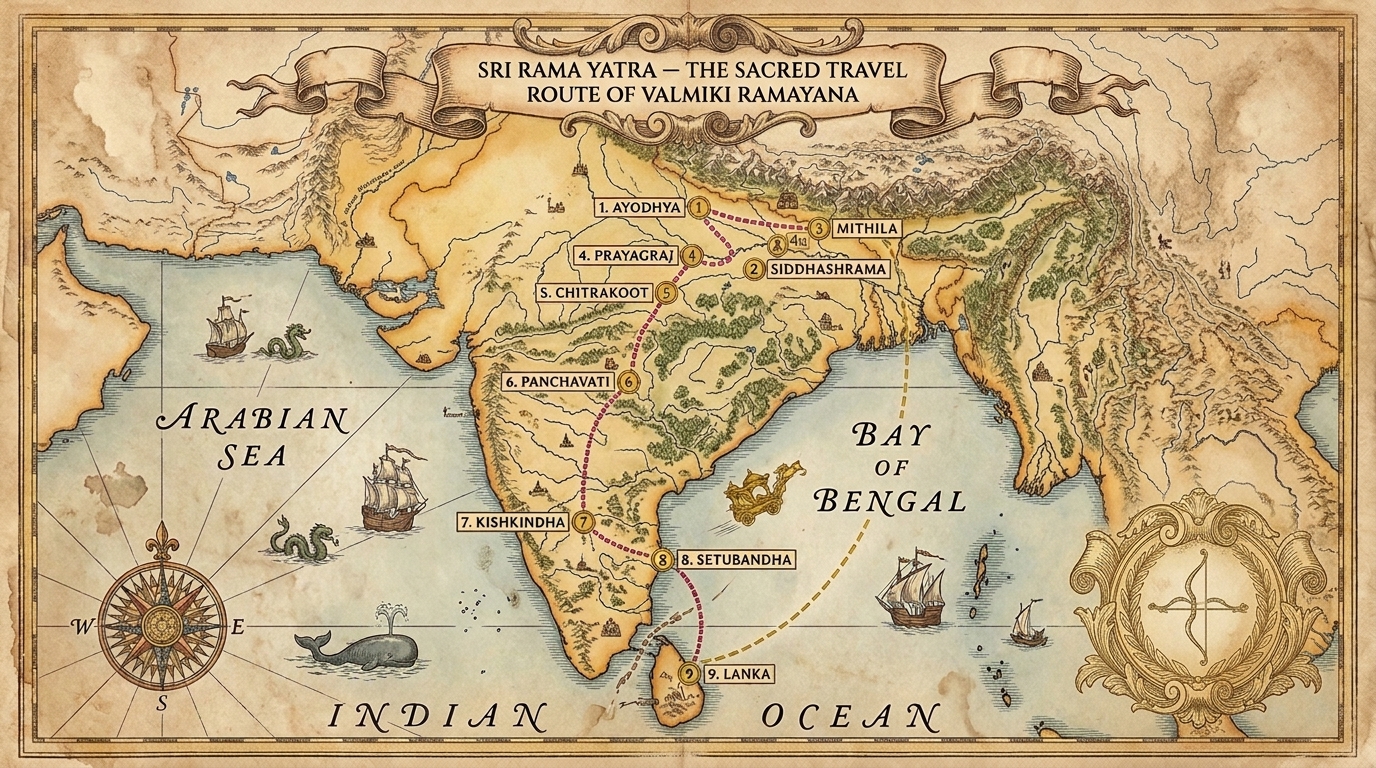
🗺️ Sacred Geography of Bharatvarsha

Sri Rama Yatra – The Sacred Travel Route of Valmiki Ramayana

From the royal banks of the Sarayu River in Ayodhya, through the hermitage groves of Chitrakoot, the deep woodlands of Dandakaranya & Panchavati, the boulder-strewn vanara kingdom of Kishkindha, to the southern shores of Rameshwaram and the fortress of Lanka—trace the epic 14-year pilgrimage route of Sri Rama, Devi Sita, and Lakshmana with antique cartography, interactive cloud callouts, and modern geographical correlations.

← Back to Ramayana Studio
🗺️ Interactive Pilgrimage Canvas
Stop 1 of 10
🧭 Vast Parchment Canvas: Click & drag or swipe to explore • Waypoint buttons smoothly glide across Bharatvarsha
Scale: 102%
Antique Cartographic Journey Map of Sri Rama Yatra
①
②
③
④
⑤
⑥
⑦
⑧
⑨
⑩
Stop 1 of 10 • Bala & Ayodhya Kanda
1. Ayodhya: The Divine Manifestation
📍 Ancient Kosala • Modern Ayodhya, Uttar Pradesh
Capital of the Solar Dynasty (Suryavamsha) along the holy Sarayu River. Birthplace of Sri Rama, royal court of Dasharatha, and departure point into the 14-year exile.
Read Full Story ↓
Stop 1 of 10 • Bala & Ayodhya Kanda 1 / 10
1. Ayodhya: The Divine Manifestation
📍 Ancient Kosala • Modern Ayodhya, Uttar Pradesh
Capital of the Solar Dynasty (Suryavamsha) along the holy Sarayu River. Birthplace of Sri Rama, royal court of Dasharatha, and departure point into the 14-year exile.
Read Full Story ↓

Chronological Journey: The 10 Sacred Waypoints

Each milestone correlates Maharishi Valmiki's authentic Sanskrit geographical descriptions with verified modern archaeological, riverine, and pilgrimage sites across India and Sri Lanka.

Waypoint ① Bala Kanda & Ayodhya Kanda

1. Ayodhya: Birth, Youth & Departure into Exile

📍 Kosala Kingdom • Sarayu River • Modern Ayodhya, Uttar Pradesh

The epic opens in the prosperous kingdom of Kosala on the banks of the sacred Sarayu River. Following King Dasharatha's Putrakameshti Yajna, Lord Vishnu manifests as the four sons of the three queens—Rama (Kausalya), Bharata (Kaikeyi), and Lakshmana and Shatrughna (Sumitra). Under the spiritual tutelage of Brahmarshi Vasishtha, Rama masters the Vedas, royal administration, and the martial sciences.

Later, on the eve of Rama's coronation as Yuvaraja (Crown Prince), Queen Kaikeyi, influenced by the maid Manthara, invokes her two boons: crowning her son Bharata and exiling Rama to the Dandaka forest for fourteen years. Upholding his father's truth (Satya-Dharma), Rama cheerfully renounces the throne, accompanied by Devi Sita and Lakshmana.

कोसलो नाम मुदितः स्फीतो जनपदो महान् । निविष्टः सरयूतीरे प्रभूतधनधान्यवान् ॥ (Valmiki Ramayana 1.5.5)
"Along the banks of the Sarayu River lies the magnificent and jubilant kingdom of Kosala, blessed with abundant wealth, grain, and virtue."
Waypoint ② Bala Kanda (Sargas 19–31)

2. Siddhashrama: Protection of Vishvamitra's Yajna

📍 Gangetic Plains • Modern Buxar, Bihar

Brahmarshi Vishvamitra arrives in Ayodhya requesting the young Prince Rama to protect his Vedic sacrifice from demon defilement. Journeying eastward along the southern bank of the Sarayu to where it merges with the Ganga, Vishvamitra initiates Rama and Lakshmana into the divine mantras Bala and Atibala, protecting them from hunger, thirst, and fatigue.

At the sacred grove of Siddhashrama, Sri Rama slays the demoness Tataka, liberates the forest, and destroys the demon Subahu while hurling Maricha across the southern ocean with his Manavastra, establishing peace for the Vedic sages.

अद्य मे सफलो यत्नः कृतश्चरितमुत्तमम् । सिद्धाश्रमोऽयं सिद्धो मे यत्सत्यं त्वयि संस्थितम् ॥ (Valmiki Ramayana 1.30.22)
"Today my spiritual endeavor has borne supreme fruit; this Siddhashrama is truly consecrated, for eternal Truth abides in Thee, O Rama!"
Waypoint ③ Bala Kanda (Sargas 48–73)

3. Mithila / Janakpur: Sita Swayamvara & Breaking of Pinaka

📍 Videha Kingdom • Foothills of the Himalayas • Modern Janakpur, Nepal

Crossing the sacred Ganga at Vaishali, Vishvamitra guides Rama and Lakshmana to the capital of King Janaka in Videha. On the outskirts of Mithila, Rama steps into the secluded ashram of Sage Gautama, restoring Mother Ahalya from her invisible ascetic penance.

At the court of King Janaka, the celestial bow of Lord Shiva (Pinaka)—which required three hundred strong men to transport in an eight-wheeled iron chest—is brought forward. With effortless grace, Sri Rama lifts the mighty bow with one hand, strings the cord, and draws it until it snaps with a thunderous roar heard across the heavens, winning the hand of Princess Janaki (Sita).

इयं सीता मम सुता सहधर्मचरी तव । प्रतीच्छ चैनां भद्रं ते पाणिं गृह्णीष्व पाणिना ॥ (Valmiki Ramayana 1.73.26)
"This is Sita, my daughter, your partner in sacred Dharma. Receive her hand in yours; may all auspiciousness be upon you both!"
Waypoint ④ Ayodhya Kanda (Sargas 50–54)

4. Shringaverapura & Prayagraj: Crossing Ganga with Guha

📍 Nishada Kingdom & Triveni Sangam • Shringverpur & Prayagraj, UP

Entering exile, Rama, Sita, and Lakshmana ride in the royal chariot driven by Sumantra until reaching Shringaverapura on the banks of the sacred Ganga. Here, Rama meets his devoted childhood friend, the Nishada tribal king Guha, demonstrating the egalitarian spirit of devotion transcending social station.

Dismissing Sumantra and the chariot, Rama and Lakshmana apply banyan sap to their locks, taking the vows of hermits (vanaprastha). Guha personally oars the royal exiles across the wide currents of the Ganga. They proceed to the holy confluence of Ganga and Yamuna at Prayagraj, receiving divine hospitality and guidance from Maharishi Bharadwaja.

गंगाकूले निवसनं गुहेन सहितो वशी । तीर्थराजं प्रयागं च जगाम रघुनन्दनः ॥ (Ayodhya Kanda 54.1)
"Resting upon the banks of the Ganga alongside Guha, the self-mastered delight of the Raghu dynasty proceeded toward the king of sacred confluences—Prayag."
Waypoint ⑤ Ayodhya Kanda (Sargas 55–119)

5. Chitrakoot: Hermitage on Mandakini & Bharata's Paduka Milap

📍 Mandakini River & Kamadgiri Hills • MP / UP Border

Following Sage Bharadwaja's advice, the exiles cross the Yamuna on a bamboo raft constructed by Lakshmana and establish a thatched leaf hermitage (Parna-Shala) upon the idyllic hills of Chitrakoot along the pristine Mandakini River. Here, the divine couple lives in deep communion with nature and holy sages.

Bharata marches to Chitrakoot with the entire royal assembly of Ayodhya, weeping at the feet of Rama and bringing the tragic news of Dasharatha's demise. Refusing to violate his father's solemn pledge, Rama gifts his gold-embossed sandals (Padukas) to Bharata. Bharata carries the sandals atop his head back to Nandigram, ruling as a humble custodian on Rama's behalf for fourteen years.

चित्रकूटं प्रविश्यैव रम्यं शैलं नरोत्तमौ । चकार वासमतुलं सीतया लक्ष्मणेन च ॥ (Ayodhya Kanda 56.35)
"Ascending the enchanting hill of Chitrakoot, the foremost of men established an incomparable dwelling alongside Sita and Lakshmana."
Waypoint ⑥ Aranya Kanda (Sargas 1–55)

6. Dandakaranya & Panchavati: Golden Deer & Sita Haran

📍 Godavari River Basin • Modern Nashik, Maharashtra

Leaving Chitrakoot after visiting Sage Atri and virtuous Mother Anasuya, Rama penetrates deep into the primeval wilderness of Dandakaranya. For nearly a decade, Rama visits holy hermitages including those of Sharabhanga, Sutikshna, and Maharishi Agastya. Agastya bestows upon Rama the celestial Vishnu bow, infallible arrows, and a golden quiver that never empties.

On Agastya's counsel, Lakshmana builds an exquisite cottage at Panchavati beside the flowing Godavari River under five sacred banyan trees. Here, the demoness Surpanakha is disfigured by Lakshmana after attacking Sita; Rama subsequently defeats Khara, Dushana, and 14,000 demons. Seeking vengeance, Ravana enlists Maricha as the illusory golden deer (Mayamriga), luring Rama and Lakshmana away before abducting Sita to Lanka.

गोदावर्या समीपे तु पञ्चवट्यां महावने । आश्रमं कुरु सौमित्रे रमणीये महीतले ॥ (Aranya Kanda 15.12)
"Near the holy Godavari in the grand forest of Panchavati, build our hermitage upon this delightful ground, O Saumitri (Lakshmana)!"
Waypoint ⑦ Kishkindha Kanda (Sargas 1–67)

7. Kishkindha: Shabari Ashram, Sugriva Alliance & Hanuman's Leap

📍 Tungabhadra River & Pampa Sarovar • Modern Hampi, Karnataka

In anguish over Sita's abduction, Rama and Lakshmana journey southwest through Krauncha forest, releasing Kabandha from his curse. Guided by Kabandha, they arrive at the tranquil shores of Pampa Sarovar, where the elderly ascetic devotee Mother Shabari serves sweet berries seasoned with pure love and attains liberation.

At Rishyamukha Hill, Rama meets Lord Hanuman disguised as a celibate scholar. Struck by Hanuman's mastery of Vedic grammar and devotion, Rama seals an eternal brotherhood with exile vanara king Sugriva over a consecrated fire. Slaying the tyrant Bali, Rama crowns Sugriva, who mobilizes millions of vanaras across the four directions. From Mount Mahendra, Hanuman takes his epochal leap across the southern ocean to locate Sita in Lanka.

ततो रामः सुग्रीवं प्रीत्या पाणिं प्रपीड्य च । सख्यं चकार वह्नौ च सान्त्वयन् वानरर्षभम् ॥ (Kishkindha Kanda 5.16)
"Then Rama grasped the hand of Sugriva with boundless affection, sealing eternal friendship before the sacred fire."
Waypoint ⑧ Yuddha Kanda (Sargas 1–22)

8. Setubandha / Rameshwaram: Construction of Ram Setu

📍 Pamban Island & Dhanushkodi • Modern Rameshwaram, Tamil Nadu

The vanara forces march south to the shores of the vast salt ocean at Setubandha. Ravana's righteous brother Vibhishana seeks shelter and is granted refuge (Sharanagati) by Sri Rama, teaching that no one who surrenders with sincere faith will ever be cast aside.

After Sri Rama meditates upon the ocean deity (Varuna), the divine architect Nala, son of Vishvakarma, designs the sacred causeway (Nala Setu / Ram Setu). Millions of vanaras and bear warriors under Jambavan gather stones, trees, and boulders, constructing a magnificent 100-yojana floating bridge across the ocean to the northern shores of Lanka in five days.

ददृशुः सर्वभूतानि सागरे सेतुबन्धनम् । अचिन्त्यमद्भुताकारं नलेन विहितं महत् ॥ (Yuddha Kanda 22.75)
"All living creatures beheld with wonder the building of the great bridge across the ocean—inconceivable, wondrous, and engineered by Nala!"
Waypoint ⑨ Yuddha Kanda (Sargas 23–128)

9. Lanka: The Great Battle & Victory Over Ravana

📍 Trikuta Mountain Fortress • Modern Sri Lanka

The allied forces encircle the golden mountain citadel of Lanka. An epic battle ensues to uphold cosmic Dharma. Lakshmana fells the sorcerer prince Indrajit, Hanuman brings the Sanjeevani hill from the Himalayas to revive fallen warriors, and Sri Rama receives the solar hymn Aditya Hridayam from Sage Agastya.

Mounting Indra's celestial chariot driven by Matali, Sri Rama invokes the supreme Brahmastra, piercing Ravana's chest and liberating the cosmos from terror. Devi Sita is reunited with Rama after undergoing Agni Pariksha, where the Fire God Agni declares her purity before all the devas, and Vibhishana is crowned king of Lanka.

स तं ददर्श धर्मात्मा रावणं निहतं रणे । रामेण विहितं कर्म सर्वलोकसुखावहम् ॥ (Yuddha Kanda 108.35)
"All beings beheld the wicked Ravana slain in battle by righteous Rama—a divine deed bestowing joy upon all three worlds!"
Waypoint ⑩ Yuddha Kanda (Sargas 123–131)

10. Pushpaka Vimana Return: Aerial Corridor to Ayodhya & Coronation

📍 Trans-Indian Aerial Route to Ayodhya, Uttar Pradesh

With the fourteen years of exile drawing to an exact close, Sri Rama, Sita, Lakshmana, Vibhishana, Sugriva, and the foremost vanara commanders board the celestial Pushpaka Vimana. Gliding northward across the clouds, Rama points out the sacred pilgrimage sites below to Sita: the battlefield of Lanka, the Setubandha ocean bridge, Kishkindha, the Godavari at Panchavati, the hills of Chitrakoot, and the Triveni Sangam at Prayagraj.

Landing at Sage Bharadwaja's hermitage, Hanuman flies ahead to Nandigram to reassure Bharata. Reunited in tears of joy, the brothers enter Ayodhya amidst triumphant conches, flowers, and Vedic chants. Brahmarshi Vasishtha and the royal priests crown Sri Rama upon the golden throne of Ayodhya, inaugurating the golden age of Ramrajya—an era of universal righteousness, peace, and abundance.

रामो रामो राम इति प्रजानामभवन् कथाः । रामभूतं जगदभूद् रामे राज्यं प्रशासति ॥ (Yuddha Kanda 128.102)
" 'Rama, Rama, Rama'—such was the sweet talk of all the citizens. The entire world was transformed into Rama's auspicious realm while He ruled the earth!"